

Blog Article
As school approaches, many parents start to worry about whether their child is ready. Should they already be reading? Writing their name? Counting to a hundred? The good news is that school readiness is less about racing ahead and more about a handful of basic skills: holding a pencil comfortably, recognising letters and numbers, following a simple instruction and staying with a task for a few minutes. All of these can be built at home, a little at a time, through play.
This guide walks through the skills that matter most in the order children usually develop them, with simple ideas you can use every day.
Step 1: Lines and Shapes Come Before Letters
Before a child can write the letter A, they need to be able to draw a slanting line, and before they can write an S they need to manage a curve. That is why pre-writing practice starts with straight lines, sleeping lines, curves, zigzags and circles. Tracing these patterns helps children get used to holding a pencil and moving it in a controlled way, without the pressure of getting a letter right.
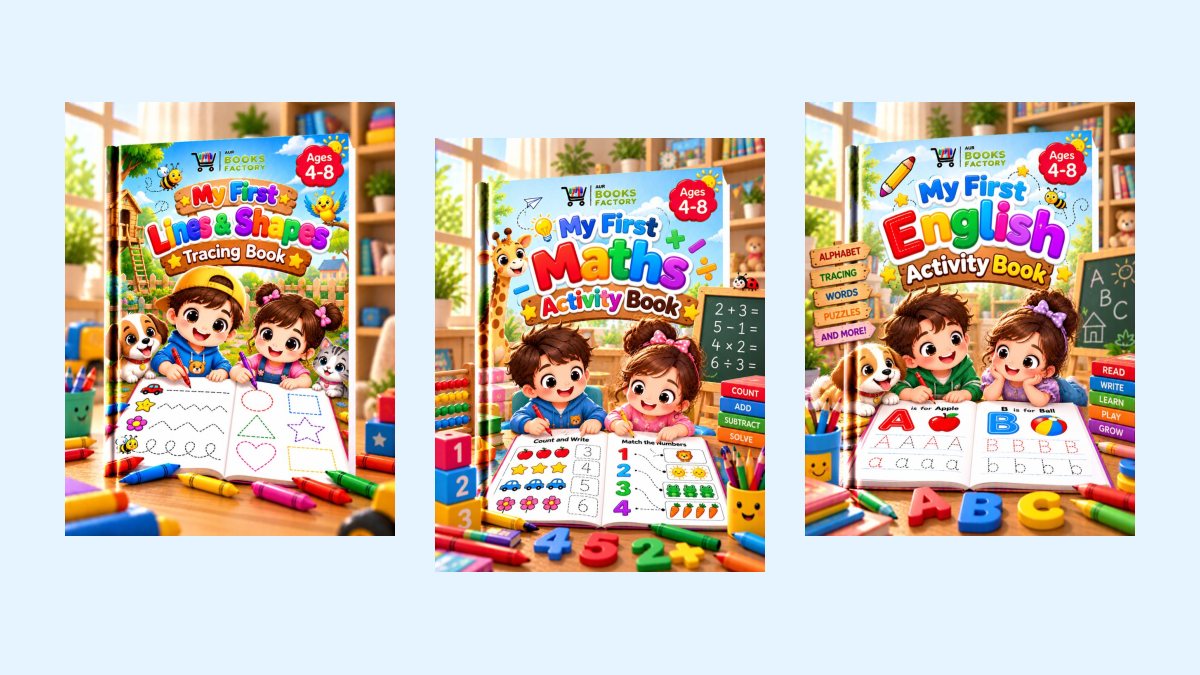
Keep this stage playful. Draw lines in sand, on a steamy mirror or with a finger in the air before moving to paper. A book like My First Lines and Shapes Tracing Book gives this practice a clear, step by step structure.
Step 2: Recognise Letters, Then Trace Them
Children learn letters best when a letter is connected to something they know: A for apple, B for ball, C for cat. Point out letters on shop signs, food packets and book covers, and say their sounds as well as their names. Once a child recognises a letter, tracing it helps them learn the correct way to form it, starting from the right point and moving in the right direction.
ABC Letter Tracing Adventure covers capital and small letters from A to Z with pictures, while My First English Activity Book adds phonics, vowels and simple word activities once your child is ready for more.
Step 3: Count Real Things Before Writing Numbers
Numbers make sense to children when they are attached to real objects. Count spoons at the table, stairs as you climb them, or cars as they pass. When your child can count a small group of objects confidently, move on to recognising and tracing the written numbers. Simple ideas like more and less, what comes before and after, and basic patterns can all be introduced through everyday talk.
123 Number Tracing Fun combines number tracing with counting and matching, and My First Maths Activity Book gently introduces shapes, patterns and beginner addition and subtraction.
Step 4: From Tracing to Writing on Their Own
Tracing is a helpful start, but the goal is for children to write without guides. The easiest path is gradual: trace a letter a few times, then copy it next to the traced version, then write it from memory. The same works for short words and, later, simple sentences. Encourage a relaxed grip and short practice sessions, since tired hands quickly lead to messy writing and frustration.
Write Right Handwriting Practice is built around exactly this progression, moving from letters to words and short sentences.
Step 5: Build Thinking Skills Through Puzzles
School readiness is not only about letters and numbers. Children also need to notice details, solve small problems and keep trying when something is tricky. Mazes, dot-to-dot pictures, spot the difference and hidden picture puzzles practise these skills while feeling like games. They are also excellent for quiet time and travel.
Try Little Explorers Maze Adventure, Connect the Dots and Discover, Brainy Kids Puzzle Challenge or Find It! Hidden Picture Challenge.
A Simple 15 Minute Daily Routine
You do not need long lessons. Short, regular practice works far better than an occasional long session. Here is one easy way to structure fifteen minutes:
- 3 minutes: warm up with lines, shapes or a quick drawing.
- 5 minutes: one tracing activity, either a letter or a number.
- 5 minutes: a fun puzzle such as a maze or dot-to-dot.
- 2 minutes: talk about what they did and praise their effort.
Rotate the activities through the week so it never feels repetitive, and pick a regular time, such as after breakfast or before bed, so it becomes a habit rather than a chore.
When to Slow Down
Every child develops at their own pace. If your child becomes upset, grips the pencil very tightly or keeps avoiding the activity, take a step back. Go back to an easier stage, make the sessions shorter or switch to drawing and colouring for a few days. Pushing too hard can turn learning into something children resist. Keeping it light and encouraging is what builds confidence, and confidence is the most useful thing a child can bring to their first day of school.
Everything in One Place
Our Activity and Learning Collection covers tracing, handwriting, maths, English, general knowledge and puzzles for ages 4 to 8. If you want to start with the three basics, the School Ready Learning Combo brings together ABC Letter Tracing Adventure, 123 Number Tracing Fun and Write Right Handwriting Practice at a lower price than buying them separately.





0 Comments
Be the first to comment on this post.