

Blog Article
Every year, as Dussehra and Diwali come closer, children start asking the same questions. Who was Ravana? Why do we burn his effigy? Why do we light diyas on Diwali night? The answers are all in one great story: the Ramayana. Sharing the Ramayana story for kids during the festive season is one of the easiest ways to help children understand what the festivals really mean.
The full epic is long, but the heart of it can be told in a few evenings. In this guide we have retold the Ramayana story in English in seven short parts, each one simple enough to read aloud in five minutes. Every part ends with a lesson and a question to talk about with your child. At the end you will find the best Ramayana books for kids to read next.
What is the Ramayana?
The Ramayana is one of the two great epics of India, along with the Mahabharata. It is traditionally believed to have been composed by the sage Valmiki, and it tells the life of Prince Rama of Ayodhya: his exile to the forest, the kidnapping of his wife Sita by the demon king Ravana, and the great battle to rescue her. Over the centuries it has been retold in almost every Indian language, including the much loved Ramcharitmanas of Tulsidas in Awadhi.
For children, the Ramayana is above all an adventure story. It has a brave prince, a loyal brother, a flying monkey hero, a ten headed villain, talking birds and a bridge across the sea. It is also full of simple values: keeping your word, respecting elders, loyalty to friends and the victory of good over evil. That is why Ramayana stories have been told to Indian children for thousands of years.
The Ramayana story for kids in 7 short parts
Read one part each night in the week before Dussehra, or all seven on a quiet afternoon. These Ramayana stories for kids are retold simply, so even a five year old can follow along.
Part 1. Prince Rama and the Great Bow
Long ago, King Dasharatha ruled the kingdom of Ayodhya. He had four sons: Rama, Lakshmana, Bharata and Shatrughna. Rama, the eldest, was brave, kind and loved by everyone. When the brothers grew up, the sage Vishwamitra took Rama and Lakshmana into the forest to protect the sages from demons, and the young princes learned much from him.
On their way back, they came to the kingdom of Mithila, where King Janaka had a daughter named Sita. Janaka had promised that Sita would marry the man who could lift and string the mighty bow of Lord Shiva. Prince after prince tried and failed. The bow would not even move. Then Rama stepped forward, lifted the bow with ease and, as he bent it to tie the string, it snapped in two with a sound like thunder. Rama and Sita were married, and there was great joy in both kingdoms.
Lesson: True strength is gentle and humble. Ask your child: Why do you think Rama did not boast after breaking the bow?
Part 2. The Promise and the Exile
King Dasharatha grew old and decided to crown Rama as king. But Queen Kaikeyi, the mother of Bharata, was persuaded by her maid Manthara that this would be bad for her son. Years earlier, the king had promised Kaikeyi two wishes. Now she asked for them: that Bharata be crowned king, and that Rama be sent to live in the forest for fourteen years.
The king was heartbroken, but he could not break his word. Rama did not argue or feel angry. He touched his father's feet and prepared to leave. Sita refused to stay behind, and Lakshmana insisted on going too. When Bharata returned and heard what had happened, he was upset. He went to the forest and begged Rama to come home. When Rama gently refused, Bharata took his brother's sandals, placed them on the throne and ruled Ayodhya in Rama's name until his return.
Lesson: Keeping a promise matters, even when it is hard. Ask your child: What does Bharata's choice tell us about him?
Part 3. The Golden Deer
For many years, Rama, Sita and Lakshmana lived peacefully in the forest. Then one day the demoness Shurpanakha, sister of Ravana, the ten headed king of Lanka, saw Rama and wanted to marry him. When she was turned away and attacked Sita, Lakshmana drove her off. She ran to her brother Ravana and told him about the beautiful Sita.
Ravana made a wicked plan. He sent the demon Maricha, disguised as a shining golden deer, to play near the hut. Sita longed for the deer, so Rama went to catch it. Far away, the deer cried out in Rama's voice, "Lakshmana, help me!" Worried, Sita begged Lakshmana to go. Before leaving, he drew a line around the hut and asked her not to step across it. In many retellings this is called the Lakshman Rekha.
Ravana then came to the hut dressed as a holy man asking for food. When Sita stepped out to give it, he seized her and flew away in his chariot. The brave old eagle Jatayu fought Ravana to save her, but Ravana cut his wings. Before he died, Jatayu told Rama which way Ravana had gone.
Lesson: Things that look too good to be true often are. Ask your child: Why was Jatayu a hero even though he lost the fight?
Part 4. Hanuman and the Monkey Army
Searching for Sita, Rama and Lakshmana walked south through the forests. On the way they met the old woman Shabari, who had waited her whole life to see Rama. She offered him wild berries, tasting each one first to make sure it was sweet. Rama ate them happily, because he cared about her love and not about the custom.
Further on, they met Hanuman, the son of the wind god, who was strong, wise and could change his size at will. Hanuman took them to Sugriva, the monkey king who had lost his kingdom. Rama helped Sugriva win back his throne, and in return Sugriva sent his whole army of monkeys and bears to search for Sita in every direction. Hanuman became Rama's most devoted friend for life.
Lesson: Love and loyalty matter more than rules and riches. Ask your child: Why did Rama happily eat the berries Shabari had tasted?
Part 5. Hanuman's Leap to Lanka
The search party reached the southern sea and learned that Sita was held in Lanka, across the ocean. No one could cross it. Then the wise bear Jambavan reminded Hanuman of his great powers. Hanuman grew huge, climbed a mountain and leapt across the sea in a single jump.
In Lanka he made himself tiny and searched until he found Sita, sad and alone in the Ashoka garden, surrounded by guards. He gave her Rama's ring to show he was a friend and promised that Rama would come. Then he let Ravana's soldiers catch him. Ravana ordered that Hanuman's tail be set on fire. Hanuman simply grew his tail longer and longer, broke free and leapt from roof to roof, setting golden Lanka ablaze before flying back to Rama with the good news.
Lesson: Believe in yourself. Sometimes others see our strength before we do. Ask your child: Who reminded Hanuman how strong he was? Has anyone ever done that for you?
Part 6. The Bridge Across the Sea
Rama's army now had to cross the ocean. Ravana's own brother Vibhishana, who had told Ravana to return Sita, was thrown out of Lanka and came to join Rama. The monkeys Nala and Nila led the building of a bridge. Every monkey and bear carried rocks and trees, and the stones floated on the water. In the popular telling, each stone carried Rama's name.
A little squirrel wanted to help too. It rolled in the sand, ran onto the bridge and shook the sand off between the stones, again and again. Some monkeys laughed at it, but Rama picked up the squirrel, thanked it and gently stroked its back. Many families still tell their children that this is how the squirrel got the three stripes on its back.
Lesson: No help is too small. Ask your child: What small thing can you do to help at home this week?
Part 7. Victory and the Return to Ayodhya
A great battle began in Lanka. Ravana's giant brother Kumbhakarna was woken from his long sleep to fight, and Ravana's son Indrajit wounded Lakshmana badly. The healer said only the Sanjeevani herb from a faraway mountain could save him. Hanuman flew there, but could not tell which herb was the right one, so he lifted the whole mountain and carried it back. Lakshmana was saved.
At last Rama faced Ravana himself. Ravana's ten heads kept growing back, until Vibhishana told Rama the secret, and Rama's arrow ended Ravana's life. This victory of good over evil is what we celebrate on Dussehra, when effigies of Ravana are burnt across India. Sita was rescued, and when the fourteen years were over, Rama, Sita and Lakshmana returned home. The people of Ayodhya lit rows of lamps to welcome them, and that, in the best known telling, is why we light diyas on Diwali.
Lesson: Good may take time, but it wins in the end. Ask your child: Why do you think the people lit lamps to welcome Rama?
How to tell the Ramayana story to young children
- Keep it short. One part a night is plenty for children under seven. Let them ask for more.
- Use voices. A deep voice for Ravana and a brave one for Hanuman turns a story into a game.
- Connect it to the festival. On Dussehra, read Part 7 before you go out to see Ravana burnt. On Diwali, light one lamp together and talk about Rama coming home.
- Use pictures. Illustrated story books for kids help little ones keep track of the many characters.
- Let them retell it. Ask your child to tell the story back to you, or act it out with toys. That is how it sticks.
Best Ramayana books for kids
A good illustrated book lets your child return to the story whenever they like. These are our picks if you want to buy books online for the festive season.
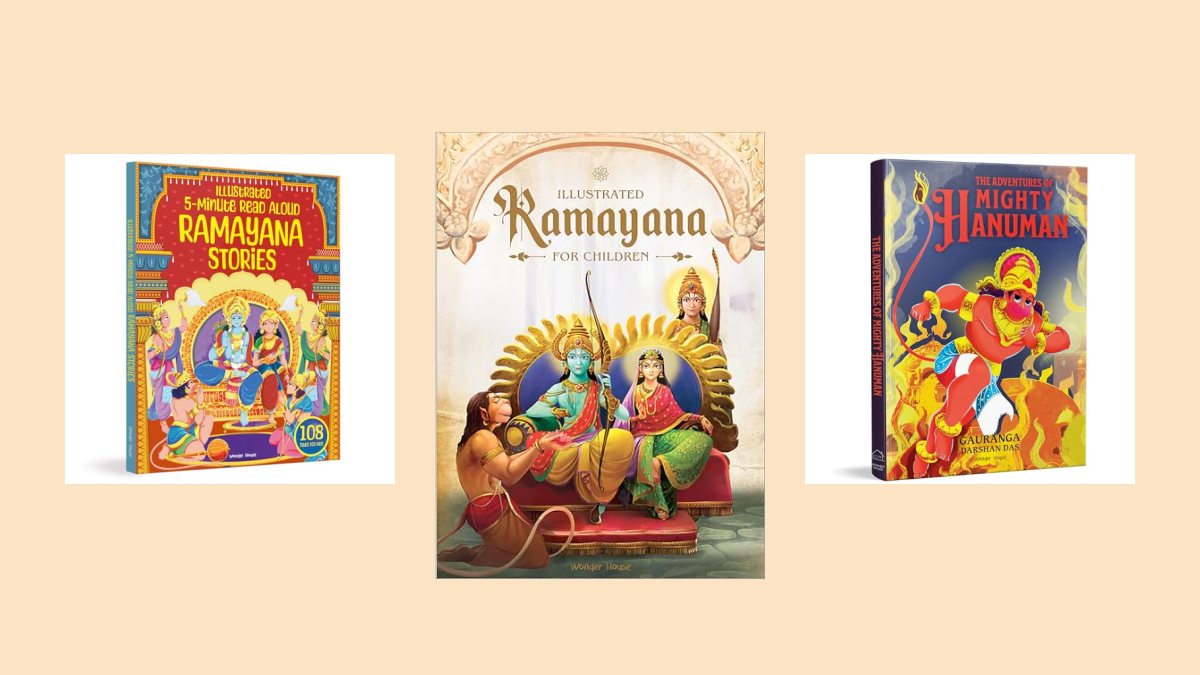
- 108 Illustrated Ramayana Stories (5 Minutes Read Aloud), short stories that are perfect for bedtime, one at a time.
- Illustrated Ramayana For Children: Immortal Epic of India (Deluxe Edition), a colourful full retelling that makes a lovely Diwali gift.
- Illustrated Ramayana For Children (Black and White), the same retelling in a simpler edition.
- Tales from Adventures of Rama For Children, easy stories for early readers.
- My First Shaped Board Book: Lord Ram, a sturdy first book for toddlers aged 2 and up.
Books about Hanuman, every child's favourite
Most children fall in love with Hanuman first. If yours does too, these books tell more of his adventures.
- The Adventures of Mighty Hanuman for Children
- Tales from Hanuman For Children
- Hanuman: Illustrated Story Book for Children in Hindi, for families who read in Hindi.
- My First Shaped Board Book: Lord Hanuman, for the youngest readers.
- Children's First Mythology Stories, Pack of 5, with Ram, Shiva, Hanuman, Ganesha and Vishnu in one set.
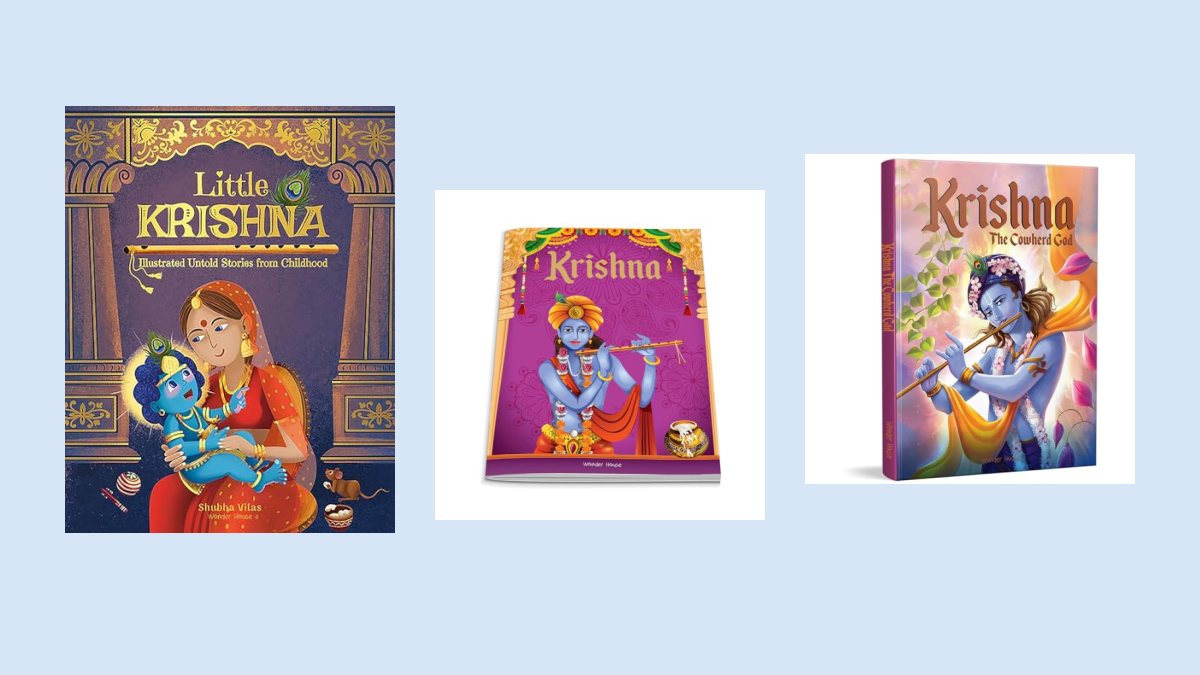
Children who enjoy the Ramayana will also love the stories of Lord Krishna. Read our guide to Krishna stories for kids, or browse all our story books for kids.
Frequently asked questions
What age is the Ramayana story suitable for? Children from about four years old enjoy the simple version read aloud. The battle scenes can be kept short for little ones. By eight or nine, most children can read a full illustrated retelling on their own.
How is the Ramayana connected to Dussehra and Diwali? Dussehra celebrates Rama's victory over Ravana, and Diwali, in the best known tradition, celebrates Rama, Sita and Lakshmana returning home to Ayodhya, when the city was lit with lamps.
Who wrote the Ramayana? The original Sanskrit Ramayana is traditionally credited to the sage Valmiki. Tulsidas later wrote the Ramcharitmanas, which is the version many families in North India know best.
Is there a short Ramayana story in English for kids? Yes. The seven parts above are a short Ramayana story in English that covers the whole epic. For more detail, an illustrated children's edition is the best next step.
Where can I buy Ramayana books for children? You can buy books online at BooksFactory with cash on delivery, including illustrated Ramayana editions, Hanuman story books and Indian mythology sets in English and Hindi.
Make it a festive tradition
This year, make the Ramayana story for kids part of your Dussehra and Diwali. Read one part each night, light a lamp together on Diwali and tell your child why. Years from now they will remember those evenings, and they may well tell the same Ramayana stories to their own children. Happy reading, and happy festivals.
0 Comments
Be the first to comment on this post.