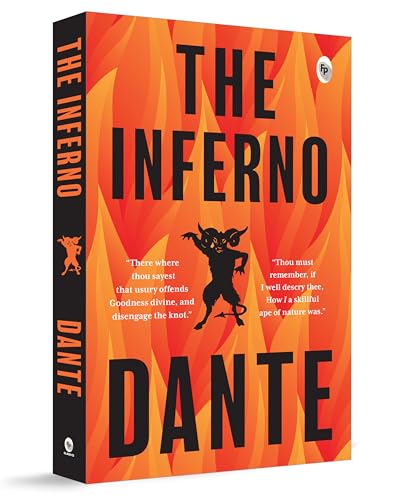
The Inferno
“Thence we came forth to rebehold the stars.” In the year 1300, on the night before Good Friday, Dante loses his way in the woods. Standing...
₹199
inclusive of all taxes · free delivery
In Stock
Cash on Delivery
Guaranteed Service
4 to 7 Business Days
Check Delivery Free delivery on all orders
Offers on this product
Coupon Code: BOOK10
Get 10% off
.
About the Book
“Thence we came forth to rebehold the stars.” In the year 1300, on the night before Good Friday, Dante loses his way in the woods. Standing in front of a mountain, he is surrounded by three beasts—a lion, a leopard, and a she-wolf. Dante cannot escape. He returns to the dark woods, unable to find a straight way, and runs into the ghost of the great Roman poet Virgil. What happens when, led by Virgil, Dante embarks on his journey to Heaven through Hell? The first part of Dante Alighieri’s epic poem Divine Comedy, Inferno deftly depicts the narrator’s allegorical journey through Hell. Composed spectacularly with rich and vivid imagery, it is considered one of the finest works in the Italian language.
About the Author
Often considered as the Father of the Italian language, Dante Alighieri is best known for his epic poem the Divine Comedy. Born in 1265 in Florence, Republic of Florence, which is present-day Italy, Dante was an eminent Italian poet, prose writer, political thinker, and philosopher. The Alighieri family was involved in Florentine politics with loyalties towards the political alliance supporting Papacy. Dante was involved in the Guelph-Ghibelline conflict, and in the year 1289, he fought the Battle of Campaldino. He held numerous significant public offices at the time of political unrest but accomplished little as a politician. In the year 1302, Dante was exiled for life. Dante travelled and wrote during his exile. The Divine Comedy was conceived during this period. Divided into three parts—Inferno, Purgatorio, and Paradiso, it describes Dante’s journey through Hell, Purgatory, and Paradise. A pre-eminent work of Italian literature, this fourteenth-century classic helped establish the Tuscan language. Some of Dante’s other works include Convivio (The Banquet), De Monarchia, Le Rime (The Rhymes), and De vulgari eloquentia (On Eloquence in the Vernacular). Dante died on his way back to Ravenna in the year 1321, aged fifty-six.
Edition
N/A
Language
English
Publisher
Fingerprint! Publishing
Binding
Paperback
ISBN-13
9788175993884
Weight
201gm
Dimension
19.6-12.6-1.6
Premium Quality
Easy Return
Certified Product
Secure Checkout
Money Back Guarantee
On Time Delivery
Related Products





Recently Viewed Books










Product Details
ISBN-139788175993884
PublisherFingerprint! Publishing
BindingPaperback
LanguageEnglish
AuthorDante Alighieri
Edition
Dimensions19.6-12.6-1.6
Weight201gm
How would you rate your experience shopping for books on Books Factory?
Very poor
Neutral
Great
Rating Snapshot
Select a row to filter reviews.
5
0
4
0
3
0
2
0
1
0
0 Reviews
No reviews yet. Be the first to review this book.
Add a Review
Only customers who've purchased this book can write a review. Buy it, and you'll be able to review it from here or from your order in My Account.