

Blog Article
The Mahabharata is the longest poem ever written, with around one hundred thousand verses. That sounds far too big for a child, but inside this great epic are dozens of short, exciting stories about brave princes, wise teachers, clever tests and true friendship. Mahabharata stories for kids teach honesty, focus, courage and respect in a way no lecture ever can.
In this guide we have retold seven famous Mahabharata stories, each one short enough to read aloud in a few minutes. Every story ends with a lesson and a question to talk about with your child. At the end you will find the best Mahabharata books for kids of every age, in English and Hindi.
What is the Mahabharata?
The Mahabharata is one of the two great epics of India, along with the Ramayana. It was composed by the sage Vyasa, and according to legend it was written down by Lord Ganesha himself. It tells the story of two families of cousins, the five Pandava brothers and the hundred Kaurava brothers, and the great war between them at Kurukshetra.
The five Pandavas were Yudhishthira, the most truthful; Bhima, the strongest; Arjuna, the greatest archer; and the twins Nakula and Sahadeva. Their wife was Draupadi, and their best friend and guide was Lord Krishna. Their cousin Duryodhana, the eldest Kaurava, was jealous of them and tried again and again to take their kingdom.
For children, the best way into the epic is not the war but the stories along the way. Here are seven of the best loved Mahabharata stories in English, told simply for young listeners.
7 famous Mahabharata stories for kids
Read these stories slowly and with expression. Give each hero a different voice, pause at the exciting moments, and let your child guess what happens next.
1. Bhishma's Promise
Long ago, King Shantanu of Hastinapur had a brave and gentle son named Devavrata. One day the king fell in love with Satyavati, a fisherman's daughter, and wished to marry her. But her father had a condition. "Only Satyavati's son may become king after you," he said. Shantanu could not take the throne away from his own good son, so he went home sad and silent.
When Devavrata learned why his father was so unhappy, he went straight to the fisherman. "I give up my right to the throne," he said. "And so that no child of mine will ever claim it, I promise never to marry." The gods were so amazed by this terrible vow that flowers rained down from the sky. From that day Devavrata was called Bhishma, the one who made the fearsome vow, and he kept his promise for his whole life.
Lesson: A promise is precious, and true love for family can mean giving something up. Ask your child: What is the hardest promise you have ever kept?
2. The Eye of the Bird
The Pandava and Kaurava princes all learned archery from the great teacher Dronacharya. One day, Drona placed a small wooden bird high in a tree. "Aim at the eye of the bird," he told his students. Then he asked each one, "What do you see?"
Yudhishthira said, "I see the tree, the branches, the bird and you, my teacher." Drona told him to step aside. The next prince said, "I see the leaves and the sky and the bird." He too was sent away. One by one, every prince described the whole scene.
Then came Arjuna. "What do you see?" asked Drona. "I see only the eye of the bird," Arjuna replied. "Nothing else." Drona smiled. "Shoot," he said. Arjuna released his arrow, and it struck the eye exactly. From that day, Drona knew Arjuna would become the greatest archer in the world.
Lesson: Focus on your goal and you will hit it. Ask your child: What helps you concentrate when you do your homework?
3. The Escape from the Palace of Wax
Duryodhana was so jealous of his cousins that he made a wicked plan. He had a beautiful palace built for the Pandavas and their mother Kunti in the town of Varanavata. It looked grand, but its walls were made of wax, lac and oil, so that it would burn in moments.
Their wise uncle Vidura found out about the plan. He could not warn them openly, so he sent a secret message and a miner who dug a long tunnel under the palace. One night the palace was set on fire, but the Pandavas and Kunti slipped through the tunnel, with mighty Bhima carrying his mother and brothers when they grew tired. They escaped into the forest, and everyone in Hastinapur believed they were dead.
Lesson: Stay alert, listen to wise friends, and help your family when they are tired. Ask your child: Why do you think Vidura sent a secret message instead of telling them openly?
4. The Questions of the Yaksha
During their years in the forest, the Pandavas grew very thirsty. Nakula went to find water and came to a clear lake. As he bent to drink, a voice boomed: "Stop! This lake is mine. Answer my questions first, then drink." Nakula was too thirsty to listen, and as soon as he drank, he fell to the ground. One by one, Sahadeva, Arjuna and Bhima came looking, ignored the voice, drank, and fell.
At last Yudhishthira arrived. He saw his brothers lying still, and he heard the voice of the Yaksha, a spirit who guarded the lake. Yudhishthira bowed politely. "I will answer your questions," he said.
"What is faster than the wind?" asked the Yaksha. "The mind," said Yudhishthira. "What is more numerous than grass?" "Our thoughts." "What is the greatest wonder in the world?" "That every day people see others leave this world, yet they live as if they themselves will be here forever." The Yaksha asked question after question, and Yudhishthira answered each one wisely.
Pleased, the Yaksha said, "I will bring back one of your brothers. Choose." Yudhishthira chose Nakula. "Why not mighty Bhima or the great archer Arjuna?" asked the Yaksha. "My father had two wives," said Yudhishthira. "I am the son of Kunti who lives. Let one son of Madri live too." The Yaksha was so moved by his fairness that he brought all four brothers back to life. He was really Dharma, the god of justice, testing his son.
Lesson: Patience, good manners and fairness are true strength. Ask your child: Why did Yudhishthira choose Nakula?
5. Krishna and the Grain of Rice
While the Pandavas lived in the forest, the Sun god had given Draupadi a magic pot, the Akshaya Patra. It gave enough food each day to feed every guest, but only until Draupadi herself had eaten.
One afternoon, after Draupadi had finished her meal and washed the pot, the short-tempered sage Durvasa arrived with thousands of his disciples. "We will bathe in the river," he said, "and then you will feed us." Draupadi was terrified. The pot was empty, and Durvasa's curses were famous.
She prayed to Krishna, and he appeared at once. "I am hungry, Draupadi," he said with a smile. "Give me something to eat." "There is nothing left!" she cried. "Bring me the pot," said Krishna. Inside, stuck to the rim, was one single grain of rice. Krishna ate it happily and said, "I am satisfied." At that very moment, Durvasa and all his disciples at the river suddenly felt so full that they could not eat another bite, and they quietly went away.
Lesson: A true friend comes when you need them most, and even a tiny gift given with love is enough. Ask your child: Who do you turn to when you are worried?
6. Abhimanyu and the Chakravyuha
Arjuna's son Abhimanyu was brave even before he was born. When he was still inside his mother Subhadra, Arjuna told her how to break into the Chakravyuha, a battle formation shaped like a spinning wheel. Abhimanyu listened from inside. But Subhadra fell asleep before Arjuna explained how to get out again.
Years later, in the great war, the enemy made the Chakravyuha, and Arjuna was far away on another part of the battlefield. Only young Abhimanyu knew how to break in. "I will open the way," he said, "and you follow me." He fought his way inside like a lion, but the other Pandavas were stopped at the entrance and could not follow. Alone and surrounded, Abhimanyu fought with amazing courage until the very end. His bravery is remembered to this day.
Lesson: Courage is admirable, but always learn a lesson all the way to the end. Ask your child: Why is it important to finish learning something before you use it?
7. The Song of the Lord at Kurukshetra
On the first morning of the great war, Arjuna asked Krishna, who was driving his chariot, to take him between the two armies. When Arjuna looked across, he saw his own teachers, uncles and cousins on the other side. His bow slipped from his hand. "I cannot fight my own family," he said, and sat down in the chariot, full of sorrow.
Krishna spoke to him gently. He explained that every person has a duty, and that we must do our duty with a calm mind, without worrying about winning or losing. He told Arjuna that the soul never dies, and that doing what is right is more important than what is easy. These teachings became the Bhagavad Gita, the Song of the Lord, one of the most famous books ever written. When Krishna finished, Arjuna picked up his bow, his mind clear and calm again.
Lesson: Do your best and your duty, and do not worry too much about the result. Ask your child: Can you think of a time when you did the right thing even though it was hard?
How to tell Mahabharata stories to children
The Mahabharata has many characters, so a few simple habits help children follow along.
- Draw the family tree. A simple drawing of the five Pandavas, Draupadi, Kunti and Krishna on one side and Duryodhana on the other makes every story easier to follow.
- Start with the gentle stories. The eye of the bird, the Yaksha's questions and Krishna and the grain of rice are perfect for younger children. Save the war stories for older ones.
- Tell one story a night. Seven stories make a perfect week of bedtime reading, especially in the festive season.
- Talk about the lesson. Ask the question at the end of each story and let your child answer in their own words.
- Use a picture book. Illustrated story books for kids help children remember who is who much better than words alone.
Best Mahabharata books for kids
If your child enjoyed these tales, a good illustrated book lets them explore the rest of the epic. Here are our favourite Mahabharata books for kids, sorted by age.
For young readers (age 4 to 8)
- Tales from Mahabharat For Children, a colourful introduction to the epic with short, simple stories.
- Tales from Arjuna For Children, all about the great archer, including the eye of the bird.
- Mahabharata: Illustrated Book For Children, the full story in a picture book paperback.
- Children's First Mythology Stories, Pack of 5, with Mahabharata, Arjuna, Krishna, Devi and Durga.
For older children (age 8 and up)
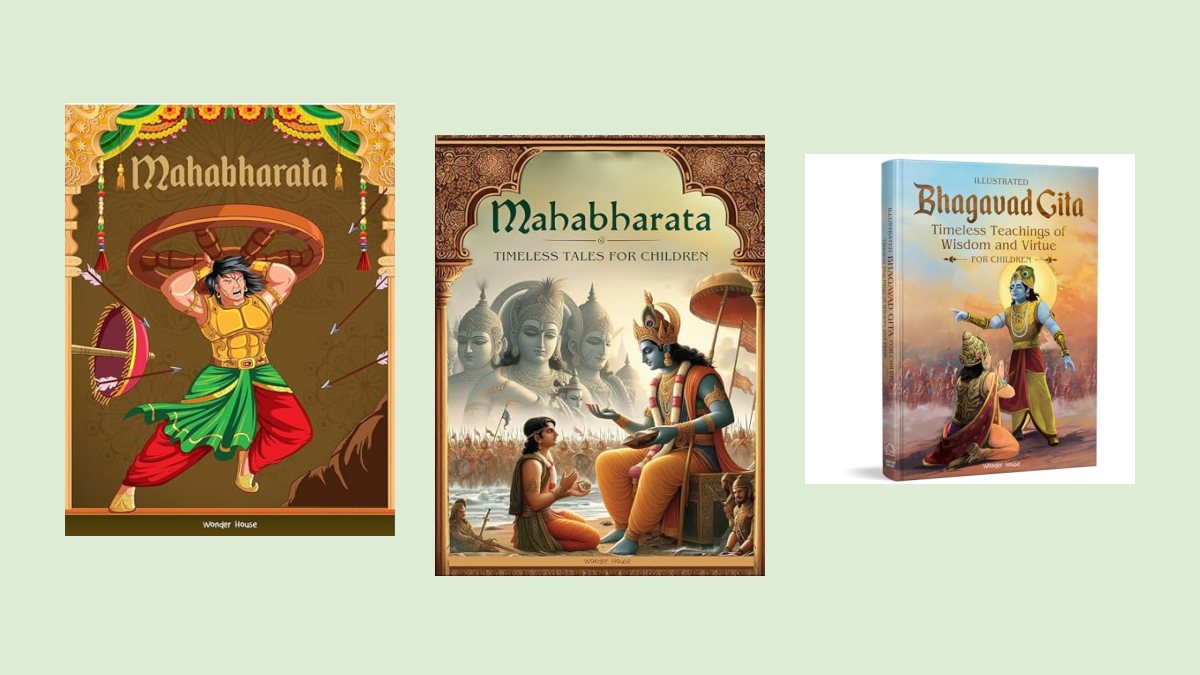
- Illustrated Mahabharata: Timeless Tales for Children (Deluxe Edition), a beautiful hardbound retelling that makes a lovely gift.
- Mahabharata: Illustrated Tales From Ancient India (Deluxe Edition), a rich illustrated edition for confident readers.
- Mahabharata: Stories of Valor and Virtue, focused on the heroes and the lessons of the epic.
- Mahabharata: The Great Indian Epic, for older children and teens ready for the complete story.
Bhagavad Gita for children
- Illustrated Bhagavad Gita for Children by Shubha Vilas, the teachings Krishna gave Arjuna, explained simply with pictures.
- Wisdom Tales From Gita For Children, short stories that bring the lessons of the Gita to life.
Mahabharata books in Hindi
- Stories from Mahabharata: Illustrated Story Book in Hindi, for children reading in Hindi.
- Arjuna: Illustrated Story Book in Hindi, the story of Arjuna in Hindi.
- Bharatiya Pauranik Devkathayein (Collection of 10 Books, Hindi), a complete Hindi mythology library.
Epic sets
- Great Indian Epics Combo, with Ramayana, Mahabharata and Little Krishna together.
- Tales from Indian Mythology (Collection of 10 Books), a complete starter library of Indian mythology.
For more stories from the same world, read our Krishna stories for kids, the Ganesha stories for kids (including how Ganesha wrote down the Mahabharata) and our Ramayana story for kids, or browse all our story books for kids.
Frequently asked questions
What age is right for Mahabharata stories? From about four, children enjoy the short, gentle stories like the eye of the bird and the grain of rice when read aloud. From seven or eight they can read illustrated Mahabharata books on their own, and by ten or twelve they are ready for the full epic and the war.
Who wrote the Mahabharata? The Mahabharata was composed by the sage Vyasa. According to legend, Lord Ganesha wrote it down as Vyasa spoke, using his own broken tusk as a pen.
What is the main lesson of the Mahabharata? The heart of the Mahabharata is dharma, doing what is right. The Pandavas win in the end because they stay truthful and fair, while jealousy and greed bring the Kauravas down.
Is the Bhagavad Gita part of the Mahabharata? Yes. The Bhagavad Gita is the conversation between Krishna and Arjuna on the battlefield of Kurukshetra, and it is part of the Bhishma Parva, the sixth book of the Mahabharata.
Where can I buy Mahabharata books for kids? You can buy books online at BooksFactory with cash on delivery, including illustrated Mahabharata books, Bhagavad Gita for children, Hindi editions and Indian mythology sets.
Start with one story tonight
Pick your child's favourite of these seven Mahabharata stories for kids and read it aloud tonight. Let Bhishma's vow ring out, make the Yaksha's voice boom across the lake, and hold your breath as Arjuna aims his arrow. Children who grow up with stories from the Mahabharata carry their lessons of truth, focus and courage for life. Happy reading.
0 Comments
Be the first to comment on this post.