

Blog Article
Few stories make Indian children laugh as reliably as Akbar Birbal stories. An emperor with a difficult question, a court full of jealous ministers, and one quick thinking man who always finds the answer: the pattern is simple, and children never tire of it. Parents like these tales for another reason. Every story quietly teaches a child to think before answering, to stay calm under pressure and to use wit instead of anger.
In this guide you will find seven famous Akbar and Birbal stories retold in simple English, each with its moral, followed by tips on reading them with children and a list of the best Akbar Birbal story books in English and Hindi.
Who were Akbar and Birbal?
Akbar was a Mughal emperor who ruled a large part of India in the sixteenth century. His court was known for its nine most gifted ministers, often called the navratnas, or nine jewels. Birbal was one of them. He was born Mahesh Das, and he became famous for his sharp mind and his sense of humour.
The stories we tell today are folk tales. They were passed on by word of mouth for hundreds of years and grew along the way, so they should be enjoyed as stories and not read as history. What they capture well is the idea of a wise adviser who is brave enough to tell a king the truth, and clever enough to do it with a smile.
Why children love Akbar Birbal stories
- Each story is a puzzle. Akbar asks a question that seems impossible. Children enjoy trying to guess Birbal's answer before it comes.
- They are short and funny. Most can be told in three to five minutes, which suits bedtime and car rides.
- Brains beat power. Birbal has no army and no crown. He wins with thinking alone, which is a pleasing idea for any child.
- They work in any language. Whether you search for Akbar Birbal stories in English or Akbar Birbal ki kahaniyan in Hindi, the humour survives the translation.
1. Birbal's Khichdi
One cold winter day Akbar announced a reward for any man who could stand all night in the freezing lake. A poor man did it and came to claim his prize. "How did you manage?" asked Akbar. "I kept looking at a lamp in the palace window, far away," said the man. "Then you took warmth from my lamp," said Akbar, and refused the reward.
The next day Birbal did not come to court. Akbar went to his house and found him sitting beside a fire, with a pot of khichdi hung high up near the ceiling. "How will it ever cook from so far away?" asked Akbar. "The same way the poor man got warmth from a lamp a mile off," Birbal replied. Akbar understood and gave the man his reward.
Moral: Be fair. Do not look for excuses to break a promise.
2. How Many Crows in the Kingdom?
To test Birbal, Akbar once asked, "How many crows are there in my city?" Without a pause Birbal answered, "Ninety five thousand four hundred and sixty three, Your Majesty." The court gasped. "And if there are more?" asked Akbar. "Then some crows have relatives visiting from other cities," said Birbal. "And if there are fewer?" "Then some of our crows have gone to visit their relatives elsewhere." Akbar burst out laughing.
Moral: A calm and confident mind can answer even an impossible question.
3. The Farmer's Well
A farmer bought a well from his neighbour. The next morning the neighbour stopped him from drawing water. "I sold you the well, not the water in it," he said. The farmer went to court for justice, and Akbar asked Birbal to settle the matter.
Birbal turned to the neighbour. "You are right. The well belongs to the farmer and the water is yours. So you must either pay him rent for keeping your water in his well, or take all of it out at once." The neighbour saw that his trick had failed and apologised.
Moral: Cheating does not pay. Those who try to be too clever get caught in their own words.
4. Make the Line Shorter
One day Akbar drew a line on the floor and said to his ministers, "Make this line shorter, but do not rub out any part of it." The ministers stared at it. Nobody could think of a way. Then Birbal stepped forward, picked up the chalk and drew a longer line beside the first one. "There, Your Majesty. Your line is now the shorter one."
Moral: You do not have to pull others down to do better. Look at a problem from a different side.
5. The Thief's Stick
A rich merchant was robbed, and he was sure the thief was one of his own servants. Birbal called all the servants and gave each of them a stick of the same length. "These are magic sticks," he said. "By tomorrow morning the thief's stick will grow two inches longer."
That night the guilty servant, afraid of being found out, cut two inches off his stick. In the morning Birbal lined up the sticks. One was shorter than all the rest, and the thief was caught.
Moral: A guilty mind gives itself away. Truth always comes out.
6. The Rooster Among the Hens
Akbar wanted to play a trick on Birbal. Before Birbal arrived, he gave an egg to each minister and told them what to do. When the court was full he said, "I had a dream that anyone who is honest will find an egg in the royal pond." One by one the ministers dived in and came out holding an egg. Then it was Birbal's turn. He dived in and found nothing.
Birbal understood at once. He climbed out flapping his arms and crowing loudly like a rooster. "What are you doing?" asked Akbar. "Your Majesty, only hens lay eggs. I am the rooster." The whole court, Akbar included, roared with laughter.
Moral: When someone tries to embarrass you, a quick mind and good humour are your best defence.
7. The List of Blind People
Akbar once said that there could not be many blind people in his city. Birbal disagreed and promised to prove it. The next day he sat in the middle of the market, mending a cot. Everyone who passed asked him, "Birbal, what are you doing?" Each time, his helper wrote the person's name on a list. Finally Akbar himself came by and asked, "Birbal, what are you doing?" His name went on the list too.
"This is the list of blind people, Your Majesty," said Birbal. "All of them could clearly see what I was doing, and still they asked."
Moral: Seeing is not the same as noticing. Use your eyes and your mind together.
How to read Akbar Birbal stories with your child
- Stop before the answer. When Akbar asks the question, close the book and say, "What would you do?" Give your child a minute. This single habit turns story time into thinking time.
- Act it out. One of you plays the emperor and the other plays Birbal. Children remember what they perform.
- Talk about fairness. Many stories, like the khichdi and the well, are about justice. Ask who was being unfair and why.
- Read in two languages. Tell the story in Hindi or your mother tongue one night and read it in English the next. The story stays the same, and the new words settle in easily.
- One story a day. These tales are short. A single story after dinner is enough to build a daily reading habit.
Best Akbar Birbal story books in English
All of these come from our children's story books shelf and have colour pictures on every page.
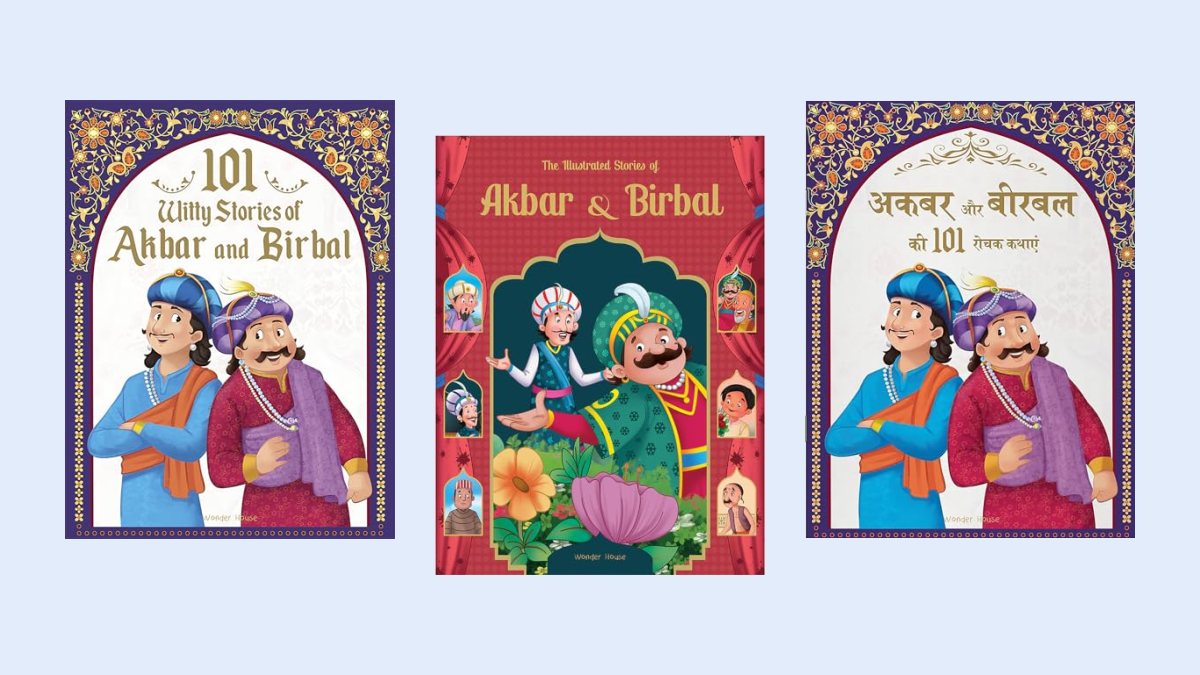
- To try one book first: Witty Stories of Akbar and Birbal - Volume 1 is a slim illustrated book, good for ages six and above. If your child enjoys it, there are ten volumes in the series.
- The full series in one box: Witty Stories of Akbar and Birbal - Collection of 10 Books makes a good birthday gift.
- One big book: 101 Witty Stories of Akbar and Birbal gives you a new story every night for more than three months.
- For younger listeners, ages 5 to 8: The Illustrated Stories of Akbar and Birbal has large pictures and simple text for reading aloud, and the Akbar Birbal Pack of 5 Books is a light set for small hands.
Akbar Birbal ki kahaniyan: best books in Hindi
Many families prefer to read these stories in Hindi, the way grandparents told them. The same illustrated series is available in Hindi.
- Akbar Aur Birbal Ki Rochak Kathayen - Volume 1, a single book to begin with.
- Akbar Aur Birbal Ki Rochak Kathayen - Collection of 10 Books, the full boxed set.
- Akbar aur Birbal ki 101 Rochak Kathaye, one large collection for older children.
If your child likes Birbal, try these next
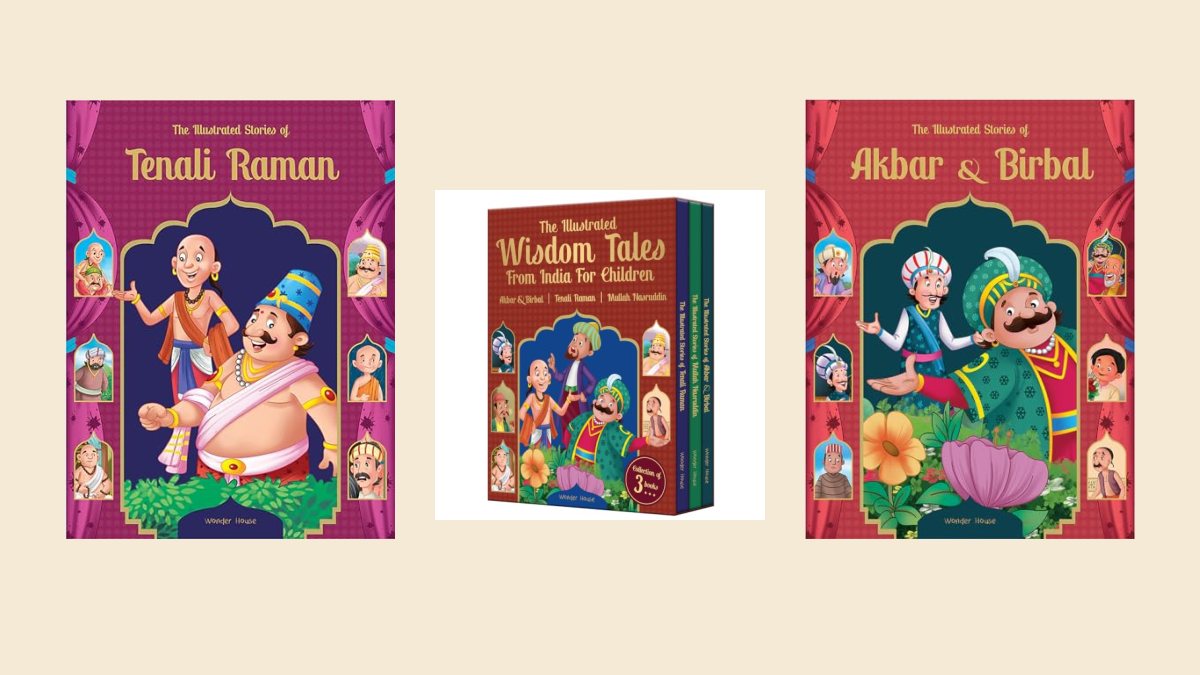
India has more than one famous wit. The Illustrated Stories of Tenali Raman brings you the clever court poet of King Krishnadevaraya, and The Illustrated Stories of Mullah Nasruddin is full of gentle, silly humour. All three heroes come together in The Illustrated Wisdom Tales from India boxed set.
For animal tales with morals, read our guide to Panchatantra stories for kids. If you are choosing books for a particular age, see best books for kids by age.
Common questions
What age are Akbar Birbal stories suitable for? Children of five and six enjoy listening to them. From about seven they can read the illustrated versions on their own, and the humour still works for ten and twelve year olds.
Are Akbar Birbal stories true? Akbar and Birbal were real people, but the stories are folk tales that grew over centuries. Treat them as fun and wise stories, not as history lessons.
Which is the most famous Akbar Birbal story? Birbal's Khichdi is probably the best known, followed closely by the crows in the kingdom and the line made shorter.
English or Hindi, which should I buy? If your child is learning to read English, choose the English edition and tell the story in Hindi first. If the aim is simply to enjoy the stories with grandparents, the Hindi edition is a lovely choice.
Start with one story tonight
Pick any story from this page and tell it at bedtime. Stop at the emperor's question and let your child guess the answer. By the end of the week you will have a child who asks for "one more Birbal story", and that is how a reading habit begins. When you want more, the full range of Akbar Birbal books and other story books for kids is waiting at BooksFactory.
0 Comments
Be the first to comment on this post.