

Blog Article
Many parents feel proud when their little one can recite one, two, three all the way to twenty. But reciting numbers is not quite the same as understanding them. A child who can chant to twenty may still pick up five spoons when you ask for three. Real number sense means knowing that each number stands for an amount, that numbers come in a fixed order, and that amounts can be compared, joined and taken apart.
The best part is that number sense grows naturally at home, through everyday routines, simple games and a little regular practice. This guide takes you step by step from the very first counting games to confident work with numbers up to 100, with ideas you can use in the kitchen, the park and at the table.
Why Number Sense Matters More Than Speed
It is tempting to measure progress by how high a child can count or how quickly they can answer a sum. But children who race ahead without understanding often get stuck later, when maths becomes more abstract. Children who truly understand what numbers mean find addition, subtraction, place value and even times tables much easier when they get there.
So in the early years, focus on understanding over speed. Ask how many, not just what comes next. Let your child touch, move and group real objects. Talk about numbers the way you talk about colours and animals, as a normal part of the day.
Stage 1: Counting Real Objects (Ages 3 and Up)
The first big idea is one to one correspondence: each object gets exactly one number. Young children often count faster than they point, or skip an object, or count the same one twice. That is completely normal. Slow down, touch each object as you count, and move it to one side once it has been counted.
The second big idea is that the last number you say tells you how many there are altogether. If your child counts five cars, ask again: so how many cars are there? If they start counting from one again, simply model the answer: five, there are five cars.
Try this at home:
- Count steps as you climb the stairs, and count them again on the way down.
- Ask your child to set the table: how many plates do we need for our family?
- Count fruit into a bowl, buttons into a jar or toys into a basket at tidy up time.
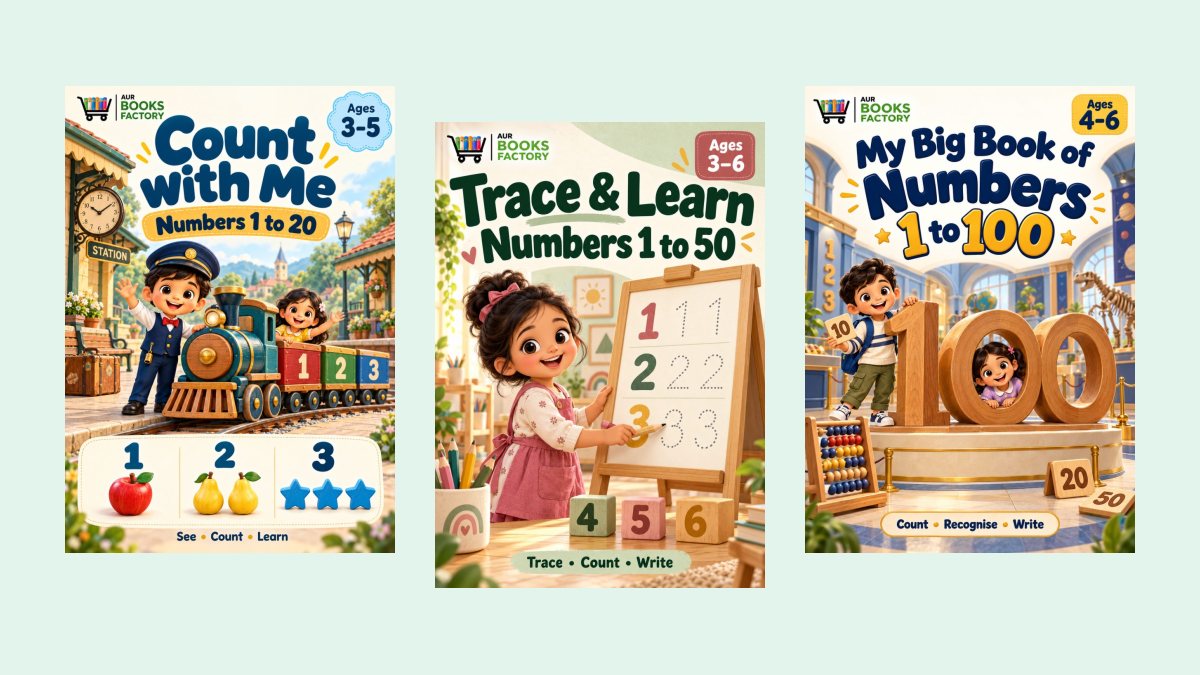
Count with Me: Numbers 1 to 20 is designed for this first stage, pairing each number with pictures to count so children connect the written numeral with a real amount.
Stage 2: Recognising and Writing Numbers
Once your child can count small groups confidently, start linking amounts to written numbers. Point out numbers everywhere: on the clock, the lift buttons, house doors, car number plates and price tags. Ask your child to find a 4 or a 7 while you are out.
Writing numbers takes a little more practice, because many digits involve curves and changes of direction. Some numbers, such as 2, 3, 5 and 9, are commonly written backwards at first. Gentle tracing practice helps children learn where to start and which way to move the pencil. Keep sessions short, as small hands tire quickly.
Trace and Learn Numbers 1 to 50 gives step by step tracing practice, and wipe clean books like Write and Wipe: Numbers 1 to 20 let children practise the same numbers again and again without using up pages.
Stage 3: Matching, Sorting and Patterns
Number sense is not only about counting. Sorting objects by colour, shape or size, spotting what is the same and what is different, and continuing a simple pattern like red, blue, red, blue are all early maths skills. They teach children to notice structure, which is at the heart of mathematics.
Try this at home:
- Sort the laundry: socks in one pile, shirts in another. Which pile has more?
- Make a pattern with pasta shapes or blocks and ask your child what comes next.
- Match number cards to groups of objects, then shuffle and match again.
Count, Match and Colour combines counting with matching and colouring, which keeps this stage playful for younger children.
Stage 4: Before, After and Between
Next, children learn that numbers live in a fixed order, like houses on a street. What comes after 6? What comes before 10? Which number sits between 14 and 16? These questions build a mental number line, which children will rely on for adding and subtracting later.
A number line on the wall or a hopscotch grid chalked outside makes this very visual. Call out a number and ask your child to jump to the number that comes after it. Before, After and Between gives focused practice on exactly this skill.
Stage 5: Comparing Amounts
Which plate has more grapes? Who has fewer blocks? Are these two groups equal? Comparing amounts helps children understand that numbers have size, and it introduces the maths words more, less and equal.
Snack time is perfect for this. Put four crackers on one plate and six on another and ask which has more, and how many more. Line up two groups side by side so your child can see the difference. Later, you can introduce the greater than and less than signs as a crocodile mouth that always wants to eat the bigger number. More, Less or Equal? takes children from comparing pictures to comparing numbers.
Stage 6: Counting to 100 and Spotting the Patterns
Counting beyond 20 can look daunting, but the numbers from 20 to 100 follow a very neat pattern. Once a child understands twenty one, twenty two, twenty three, the same pattern repeats with thirty, forty and so on. The trickiest parts are usually the changes from one ten to the next, such as 29 to 30 or 59 to 60.
A 100 square, a grid of numbers in ten rows of ten, is one of the most useful tools at this stage. Children can see that every number in a column ends with the same digit, and that each row starts a new ten. Colour in all the numbers that end in 5, or trace a path by counting in tens: 10, 20, 30, all the way to 100.
Try this at home:
- Count in tens using bundles of ten straws or ice cream sticks held with a rubber band.
- Play a counting game on a 100 square with a dice and small toys as counters.
- Count the days of the school term or holidays on a calendar.
My Big Book of Numbers 1 to 100 is made for this stage, with plenty of room to recognise, trace, write and play with bigger numbers. For extra repeat practice, Write and Wipe: Numbers 1 to 100 works well alongside it.
Stage 7: First Adding and Taking Away
When children are comfortable with counting and comparing, they are ready to join groups together and take some away. Start with real objects and stories, not written sums. You have three apples and I give you two more. How many do you have now? There were five birds on the wall and two flew away. How many are left?
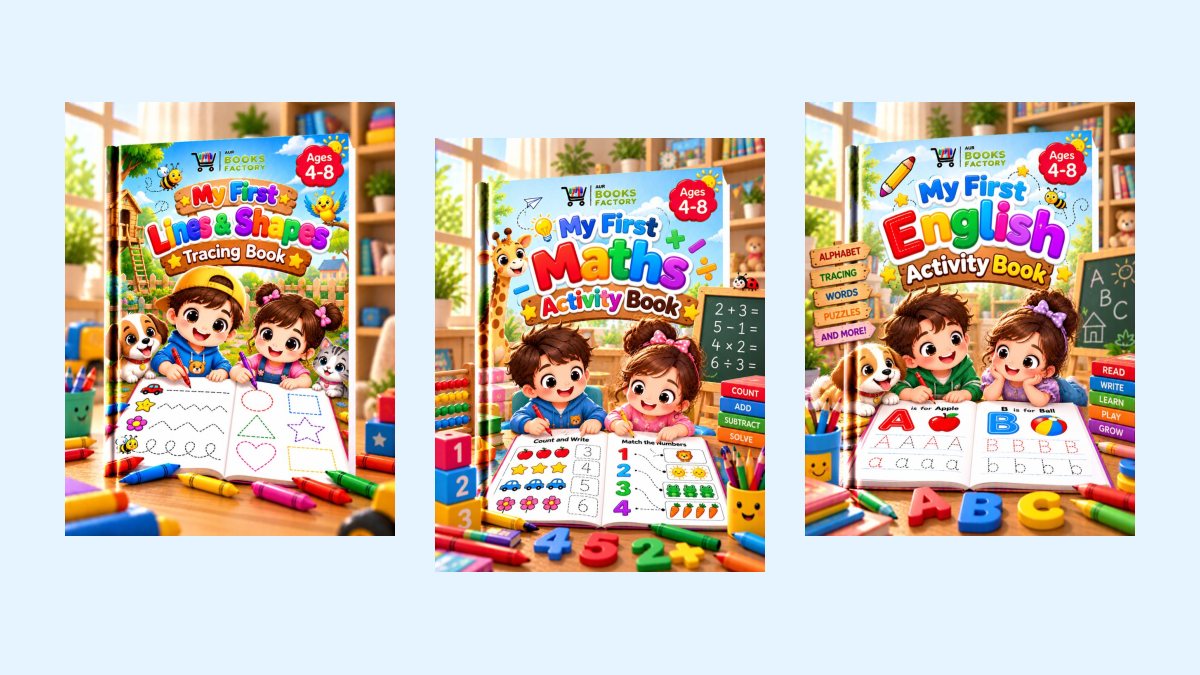
Only once your child understands what is happening should you introduce the plus, minus and equals signs. Using fingers, counters and number lines at this stage is not cheating. It is exactly how understanding is built. My First Addition and My First Subtraction introduce each operation separately, with plenty of pictures to support counting.
Everyday Maths Is Everywhere
Some of the richest number practice happens without a book or a worksheet at all. Children learn a great deal simply by being included in everyday tasks and hearing numbers used naturally.
- In the kitchen: count spoons of flour, share out biscuits fairly, talk about half and whole.
- At the shop: find the price tags, count coins, choose which pack has more.
- On a walk: count red cars, read house numbers, notice which numbers are odd and even.
- At play: board games with dice are wonderful for counting on and recognising amounts at a glance.
A 10 Minute Daily Number Routine
As with reading, a little practice every day works far better than a long session once a week. Try this simple routine:
- 2 minutes: count out loud together, forwards and sometimes backwards.
- 3 minutes: a hands on activity with real objects, such as counting, sorting or comparing.
- 3 minutes: one page of tracing or a short activity from a workbook.
- 2 minutes: a quick number game, like finding numbers around the room.
Common Mistakes to Avoid
- Moving to written sums too early. Keep using objects until your child clearly understands what adding and taking away mean.
- Only counting forwards. Counting backwards from 10 or 20 is just as important and prepares children for subtraction.
- Worrying about reversed numbers. Writing 3 or 7 backwards is common in young children and usually fades with practice.
- Turning it into a test. Asking question after question can make maths feel stressful. Play alongside your child instead.
- Saying you are bad at maths. Children pick up our attitudes quickly. Show that numbers can be fun and interesting.
Build Strong Number Foundations
Every child learns numbers at their own pace, and the goal in the early years is understanding and enjoyment, not speed. Our Maths Made Fun series follows the same steps as this guide, from first counting to numbers up to 100 and beginner addition and subtraction. Choose the book that matches where your child is today, keep practice short and cheerful, and watch their confidence with numbers grow.


0 Comments
Be the first to comment on this post.