

Blog Article
Few moments in parenting feel as magical as the first time your child looks at a word and reads it out loud. For most children, that moment does not arrive by memorising whole words. It comes from phonics: understanding that letters stand for sounds, and that those sounds can be blended together to make words. Once a child cracks this code, reading stops being a mystery and becomes a skill they can build on every day.
The good news is that you do not need to be a teacher to support phonics at home. What children need most is a clear order to learn things in, short and regular practice, and a grown up who makes it fun. This guide walks through each stage of the phonics journey, what it looks like at home, and simple activities you can start today.
Why Phonics Works
English has 26 letters but around 44 sounds. Children who learn only letter names (ay, bee, see) often struggle when they try to read, because the names do not match how the letters sound inside words. The letter c is called see, but in the word cat it says k. Phonics teaches the sound first, so when a child sees c, a and t, they can say k, a, t and blend them into cat.
This gives children a tool they can use on words they have never seen before. Instead of guessing from a picture or waiting for an adult to tell them, they can work the word out themselves. That independence is what builds real reading confidence.
Stage 1: Letter Sounds (Ages 4 and Up)
Start with the sounds of single letters. Say the pure sound, as short and clean as you can. The letter m is mmm, not muh. The letter s is sss, not suh. Adding an extra uh sound makes blending much harder later on, so it is worth getting right from the start.
You do not need to teach the alphabet in order. Many parents begin with s, a, t, p, i and n, because these letters can quickly be combined into lots of simple words such as sat, pin, tap and pan. Introduce two or three new sounds a week and keep revisiting the old ones.
Try this at home:
- Play I Spy with sounds: I spy something that starts with sss. (Sofa, spoon, sock.)
- Stick a letter on the fridge each week and hunt for things around the house that begin with its sound.
- Trace a letter in the air, on your child's back or in a tray of salt while saying its sound.
A to Z Letter Sounds is built around exactly this first step, pairing every letter with its sound and a picture your child will recognise.
Stage 2: Hearing Sounds at the Start and End of Words
Before children can read a word, they need to hear the separate sounds inside it. This skill is called phonemic awareness, and it is mostly done with ears, not eyes. Ask your child what sound they hear at the beginning of dog, or at the end of bus. At first they may find the ending harder than the beginning. That is completely normal.
Games work brilliantly here because there is no pencil and no pressure. You can do them in the car, at the dinner table or while waiting in a queue.
- Odd one out: say three words such as cat, cup and pen, and ask which one starts with a different sound.
- Sound sorting: put a few toys on the floor and sort them into groups by their first sound.
- Last sound tag: you say a word, your child says a new word that starts with your last sound. Dog, goat, tent, top.
For quiet practice on paper, Find the Beginning Sound and Fun with Ending Sounds turn this listening skill into picture activities children can do on their own.
Stage 3: Short Vowels, the Heart of Every Word
The five vowels, a, e, i, o and u, appear in almost every English word, so they deserve extra attention. Begin with the short vowel sounds: a as in apple, e as in egg, i as in insect, o as in orange and u as in umbrella. Many children mix up e and i in particular, so give these two a little more practice.
A simple trick is to give each vowel an action. Pretend to bite an apple for a, crack an egg for e, wiggle your fingers like an insect for i. Movement helps the sound stick. My First Short Vowel Sounds gives children plenty of practice in hearing and spotting each one.
Stage 4: Blending CVC Words
This is the big breakthrough. CVC stands for consonant, vowel, consonant: three letter words like cat, sun, pig, hop and bed. They are the perfect first words to read because every letter makes its simplest sound.
Show your child how to say each sound and then push them together. Some parents call this sound talk: c, a, t, cat. At first your child may say the sounds correctly but struggle to hear the word. Say the sounds a little faster each time until the word pops out. Celebrate the first success, because it really is a big deal.
Try this at home:
- Write three letters on separate cards and slide them closer together as your child blends faster.
- Build a word, then change just one letter. Cat becomes hat, hat becomes hot, hot becomes hop. Children love seeing how one small change makes a new word.
- Hide CVC word cards around the room. Your child reads each one they find and brings it back.
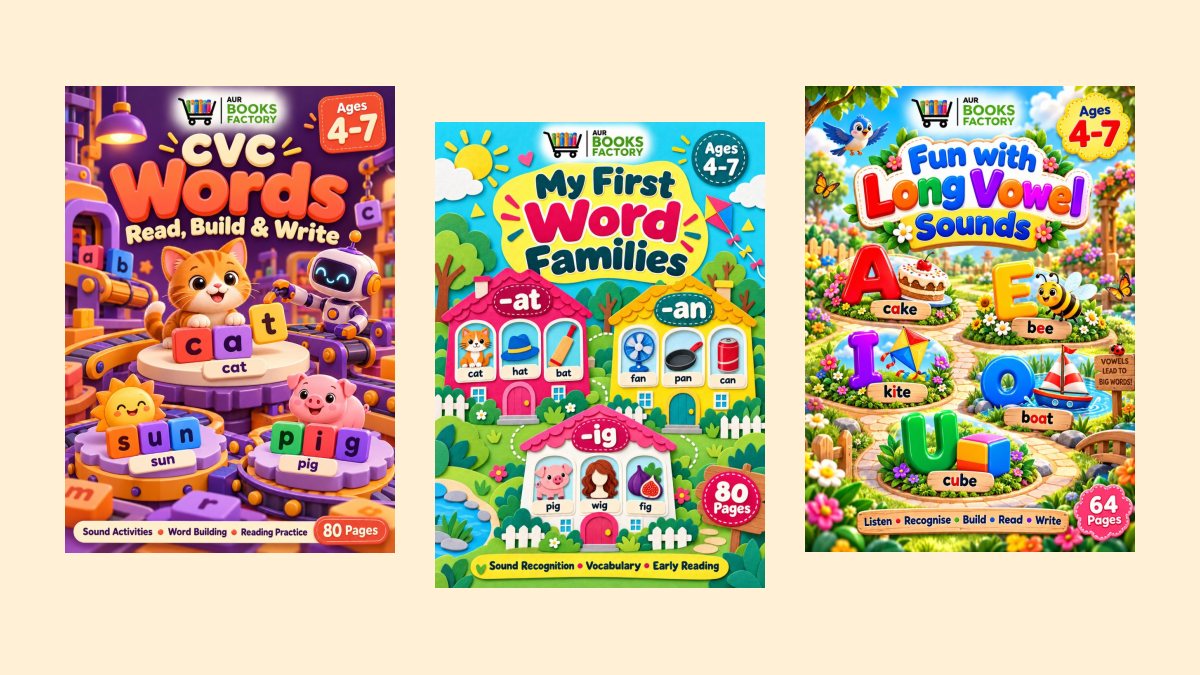
CVC Words: Read, Build and Write covers all three parts of this stage. Children read the word, build it from its sounds and then write it, which helps the pattern stay in their memory.
Stage 5: Word Families
Once your child can blend CVC words, word families help them read faster. A word family is a group of words that share the same ending, such as cat, hat, bat and mat, or pig, wig, dig and fig. When a child recognises the at chunk, they only need to change the first sound to read a whole set of new words.
This is also a wonderful stage for rhyming. Make up silly rhymes together, read rhyming picture books and ask your child to think of as many words as they can that end the same way. My First Word Families groups the most common families into friendly sets so your child can see the patterns clearly.
Stage 6: Long Vowels
Now children discover that vowels can also say their own name. The a in cake, the e in bee, the i in kite, the o in boat and the u in cube are all long vowel sounds. Long vowels are often made by pairs of letters or by a silent e at the end of the word, which is why this stage comes after children are comfortable with short vowels.
A fun way to show the silent e is the magic e game. Write cap, then add an e at the end and read it again: cape. Try it with pin and pine, hop and hope, cub and cube. Children are amazed that a letter they cannot hear changes the whole word. Fun with Long Vowel Sounds takes children through listening, recognising, building, reading and writing words with each long vowel.
Stage 7: Blends and Digraphs
Blends are two consonants that sit side by side and keep their own sounds, like cr in crab, st in star and bl in blue. Children learn to say both sounds quickly, one after the other. Digraphs are different: two letters that join to make one new sound, like sh in ship, ch in chip and th in thumb.
These can feel tricky at first, so go slowly and keep using real objects and pictures. A walk outside is full of blends and digraphs: tree, grass, flower, shop, bench. Blends Made Easy and Digraphs Made Easy each focus on one of these skills so children are not trying to learn both at once.
Stage 8: Sight Words and Simple Sentences
Some very common words do not follow the usual rules, or are needed long before a child has learned the rule behind them. Words like the, was, said, you and they fall into this group. These are called sight words, and children learn them by seeing them again and again until they recognise them instantly.
Teach just a few at a time, and use them in real sentences as soon as possible. My First Sight Words Level 1 and Super Sight Words Level 2 introduce them in a steady order. When your child is ready to put everything together, Read My First Sentences and the Phonics Reading Fun books give them short, decodable reading practice that builds fluency and confidence.
A 10 Minute Daily Phonics Routine
Short and regular beats long and occasional. Ten minutes a day, at the same time each day, will do more than an hour once a week. Here is a simple structure you can follow:
- 2 minutes: quick review of sounds your child already knows, using cards or a book page.
- 3 minutes: one new sound or skill, with an action or a picture to help it stick.
- 3 minutes: blending or reading practice, such as building three or four words.
- 2 minutes: a game or a short read together, ending on something your child can do easily.
Always finish while your child is still enjoying it. If they ask for more, that is a sign the routine is working.
Common Mistakes to Avoid
- Rushing ahead. If blending is shaky, stay with CVC words for longer. Every later stage depends on it.
- Adding extra sounds. Keep sounds pure. Buh, ah, tuh does not blend into bat nearly as easily as b, a, t.
- Correcting every slip. Let small mistakes go sometimes, and praise the effort. Confidence grows faster than accuracy at first.
- Guessing from pictures. Pictures are lovely, but gently point your child back to the letters so they practise decoding rather than guessing.
- Comparing with other children. Some children click with phonics at four, others at six. Both are perfectly normal.
How to Know Your Child Is Ready for the Next Step
Move on when your child can do the current stage without much help on most days. For example, if they can blend most CVC words on their own and only occasionally need you to model the sounds, they are ready for word families. If a new stage feels too hard, simply step back for a week. Going back is not failure. It is how strong foundations are built.
Start Your Phonics Journey
Phonics is a journey of small steps, and every step your child takes is worth celebrating. Our Phonics Path series follows the same order as this guide, from first letter sounds to reading complete sentences, so you always know what comes next. Pick the book that matches where your child is today, keep practice short and playful, and enjoy watching them become a confident reader.


0 Comments
Be the first to comment on this post.