

Blog Article
Navratri is one of the most joyful festivals in India. For nine nights homes glow with diyas, families dress in bright colours, children dance garba and dandiya, and everyone prays to Durga Maa. But when your child asks "Why do we celebrate Navratri?", do you know the story to tell them? A good Navratri story for kids turns a festival of lights and music into something children understand and remember.
In this guide we have retold seven famous Durga Maa stories in simple English, from the day the gods joined their powers to create Durga to the great battle with Mahishasura that ends on Vijayadashami. Each story is short enough to read aloud at bedtime and ends with a lesson and a question for your child. You will also find the 9 forms of Durga explained simply, easy Navratri activities for children and the best Durga books for kids in English and Hindi.
Who is Durga Maa?
Durga is the mother goddess, the brave protector of the world. She is shown riding a lion or a tiger, with many arms, each holding a weapon given to her by a different god. Her name means "the one who cannot be defeated". Even though she is a fierce warrior, she is also a loving mother to all her devotees, which is why people lovingly call her Durga Maa or Mata Rani.
Durga is a form of Parvati, the wife of Lord Shiva and the mother of Ganesha and Kartikeya. She has many other forms too, such as Kali, Chandi, Ambe and the nine forms worshipped during Navratri. Each form shows a different side of her: gentle, wise, strong or fearless.
Why we celebrate Navratri
Navratri means "nine nights". It celebrates the victory of good over evil. The most popular story of Navratri is the story of Durga and the buffalo demon Mahishasura, who fought for nine days and nights and was defeated on the tenth day, called Vijayadashami or Dussehra. In many parts of India, Dussehra also marks the day Lord Rama defeated Ravana, so the tenth day is a double celebration of good winning over evil.
Here are seven Durga stories for kids, told simply for young listeners.
7 famous Durga Maa stories for kids
Read these stories with feeling. Let your child roar like Durga's lion, count the nine nights on their fingers and cheer when good wins. Pause at the exciting moments to ask what they think will happen next.
1. How Durga Maa Was Born
Long ago, a demon named Mahishasura prayed for many years to Lord Brahma. Pleased with his prayers, Brahma offered him a blessing. "Make me so strong that no man and no god can ever defeat me," said Mahishasura. Brahma granted his wish.
Mahishasura became proud and cruel. He attacked heaven, chased away Indra and the other gods and took their homes. The worried gods went to Brahma, Vishnu and Shiva for help. When they heard what Mahishasura had done, the three great gods became so angry that a dazzling light burst out of them. The light from every other god joined it, and from this great glow appeared a goddess more beautiful and powerful than anyone had ever seen. She was Durga.
Each god gave her a gift. Shiva gave her his trident, Vishnu gave her his spinning discus, Indra gave her his thunderbolt, Varuna gave her a conch shell and Himavan, the king of the mountains, gave her a mighty lion to ride. With ten arms and ten weapons, Durga was ready to protect the world.
Lesson: When people join their strengths together, they can solve any problem. Ask your child: When did you and your friends do something together that you could not do alone?
2. Durga and Mahishasura: The Nine Day Battle
Mahishasura laughed when he heard that a goddess had come to fight him. "I cannot be defeated by any man or god," he boasted, "so what can a woman do?" He had forgotten that his blessing did not protect him from a goddess.
He sent his biggest generals and his huge army. Durga rode into battle on her lion and defeated them one by one. Then Mahishasura himself came to fight. He was clever and kept changing his shape. First he became a buffalo, then a lion, then a man with a sword, then an elephant, and then a buffalo again. Each time, Durga was ready for him.
The battle went on for nine days and nine nights. On the tenth day, as Mahishasura was coming out of his buffalo form, Durga struck him with her trident and the demon was finally defeated. The gods showered flowers on her and called her Mahishasuramardini, the one who defeated Mahishasura. That is why we pray to Durga for nine nights during Navratri and celebrate her victory on the tenth day.
Lesson: Pride and cruelty never win in the end, and being underestimated is no reason to give up. Ask your child: Why do you think Mahishasura kept changing his shape?
3. Parvati and Her Great Prayer
Before she was known as Durga, the goddess was born as Parvati, the daughter of Himavan, the king of the mountains. That is why her first Navratri form is called Shailaputri, the daughter of the mountain.
From a young age, Parvati wished to marry Lord Shiva. But Shiva was a great yogi who sat in deep meditation high in the snowy Himalayas and did not notice anyone around him. Parvati decided she would win his heart through patience and prayer. She went into the forest and prayed for years. In summer she sat in the hot sun, in winter she sat in the icy cold, and she lived only on leaves and then on nothing but air.
At last Shiva came to test her. He came disguised as an old man and said many unkind things about Shiva to see if she would change her mind. Parvati refused to listen. "Nothing you say will change my heart," she said. Shiva was so moved by her devotion that he showed his true form and agreed to marry her. This patient, praying Parvati is the second Navratri form, Brahmacharini.
Lesson: Patience and hard work help us reach even the most difficult goals. Ask your child: What is something you want to get better at if you keep practising?
4. Kali and the Demon Raktabija
One day Durga faced a very strange demon called Raktabija. He had a magic blessing: every time a drop of his blood fell to the ground, a new copy of him sprang up. The more the gods fought him, the more Raktabijas there were, until the whole battlefield was full of them.
Durga knew she needed a new plan. From her forehead appeared Kali, a dark and fearsome goddess with a long tongue and a garland of flowers. Kali spread out her tongue and caught every drop before it could touch the earth, so no new demons could grow. Without his copies, Raktabija grew weaker and weaker until Durga defeated him.
Kali can look scary, but she is a protector who fights only the forces of evil. In Bengal and many other places she is worshipped with great love as Ma Kali, and Kali Puja is celebrated on the night of Diwali.
Lesson: When something is not working, think in a new way. Ask your child: What clever idea did Kali have to solve the problem?
5. Chamunda and the Demons Chanda and Munda
Two demon brothers, Shumbha and Nishumbha, wanted to rule the world. They sent their generals Chanda and Munda with a huge army to capture the goddess. The demons marched up the mountain with swords and arrows, sure they would win.
But Durga was not afraid. A fierce goddess appeared from her, rode into the army and defeated Chanda and Munda. Because she had beaten these two generals, she was given the name Chamunda. Later, Durga defeated Shumbha and Nishumbha too, and the gods sang her praises in a beautiful hymn called the Devi Mahatmya, which many families still read during Navratri.
Lesson: True courage means standing firm even when the challenge looks very big. Ask your child: What makes you feel brave when you are scared?
6. Lord Rama Prays to Durga
This story links Navratri with Dussehra. Before his great battle with Ravana, Lord Rama wanted the blessings of Durga Maa. He decided to worship her with 108 blue lotus flowers. Hanuman flew far and wide and brought back exactly 108 lotuses.
Rama began his prayer and offered the flowers one by one. But when he reached the last one, it was gone. The goddess had hidden it to test him. Rama did not get upset or give up. People called him Kamalnayan, the lotus eyed one, because his eyes were as beautiful as lotus flowers. "I will offer one of my own eyes in place of the missing lotus," he said, and he picked up an arrow.
Before he could do it, Durga Maa appeared and stopped him. She was so pleased with his devotion that she blessed him with victory. Soon after, Rama defeated Ravana on the tenth day, Vijayadashami. You can read the whole story in our Ramayana story for kids.
Lesson: When we give our best with a true heart, help comes to us. Ask your child: Why do you think the goddess hid the last lotus?
7. Durga Maa Comes Home: The Story of Durga Puja
In Bengal, people tell a sweet story about Durga Puja. Every year, Durga leaves her home with Shiva on Mount Kailash and travels down to earth to visit her parents, just like a daughter coming home for the holidays. She brings her four children with her: Ganesha, Kartikeya, Lakshmi and Saraswati.
For those few days the whole town celebrates her visit. People build beautiful pandals, decorate huge idols of Durga and her children, play the dhak drums, dance and share delicious food. On the last day, called Bijoya Dashami, the idols are carried to the river with songs and tears, and everyone says goodbye with the hope that she will come back next year. Married women play sindoor khela, smearing red sindoor on each other, and everyone hugs and shares sweets.
Lesson: Festivals are about family, love and coming together. Ask your child: Who do you most love visiting during the holidays?
The 9 forms of Durga in Navratri
Each night of Navratri is dedicated to one of the 9 forms of Durga, together called Navdurga. Here they are, explained simply for children:
- Day 1, Shailaputri: the daughter of the mountain king, who rides a bull and holds a trident and a lotus.
- Day 2, Brahmacharini: the young Parvati who prayed with great patience, holding prayer beads and a water pot.
- Day 3, Chandraghanta: she wears a half moon shaped like a bell on her forehead, and the sound of her bell scares away evil.
- Day 4, Kushmanda: it is said she created the universe with her warm smile, filling the dark with light.
- Day 5, Skandamata: the loving mother of Kartikeya, also called Skanda, whom she holds on her lap.
- Day 6, Katyayani: the brave warrior form, born in the home of the sage Katyayana, who defeated Mahishasura.
- Day 7, Kalaratri: the fiercest form, dark as night, who destroys darkness and fear.
- Day 8, Mahagauri: calm and shining white, she brings peace and purity. Many families do kanya pujan on this day.
- Day 9, Siddhidatri: the giver of wisdom and blessings, sitting on a lotus. Many families do kanya pujan on this day too.
A simple idea for children: give them one colour for each day of Navratri and let them draw or colour that day's goddess. By the ninth night, they will have their own Navdurga picture book.
Easy Navratri activities for kids
- Story a night: read one of the seven stories above each night, and use the last two nights for the 9 forms of Durga.
- Garba and dandiya: teach your child a few simple steps at home or take them to a family garba night.
- Golu or kolu: in South India, families arrange dolls on steps. Let your child pick and place their own dolls and tell the story of each one.
- Colour a goddess: spiritual colouring books are a calm way to keep little hands busy while the stories sink in.
- Kanya pujan: explain to your child why young girls are honoured as forms of the goddess, and let them help serve the puri, chana and halwa.
- Make a lion mask: Durga's lion is a favourite with every child. A paper plate, some yellow paint and wool for the mane are all you need.
Best Durga books for kids
Stories stay with children longer when they can see the pictures and come back to them again and again. These Durga books for kids are all available at BooksFactory.
For toddlers (ages 1 to 4)
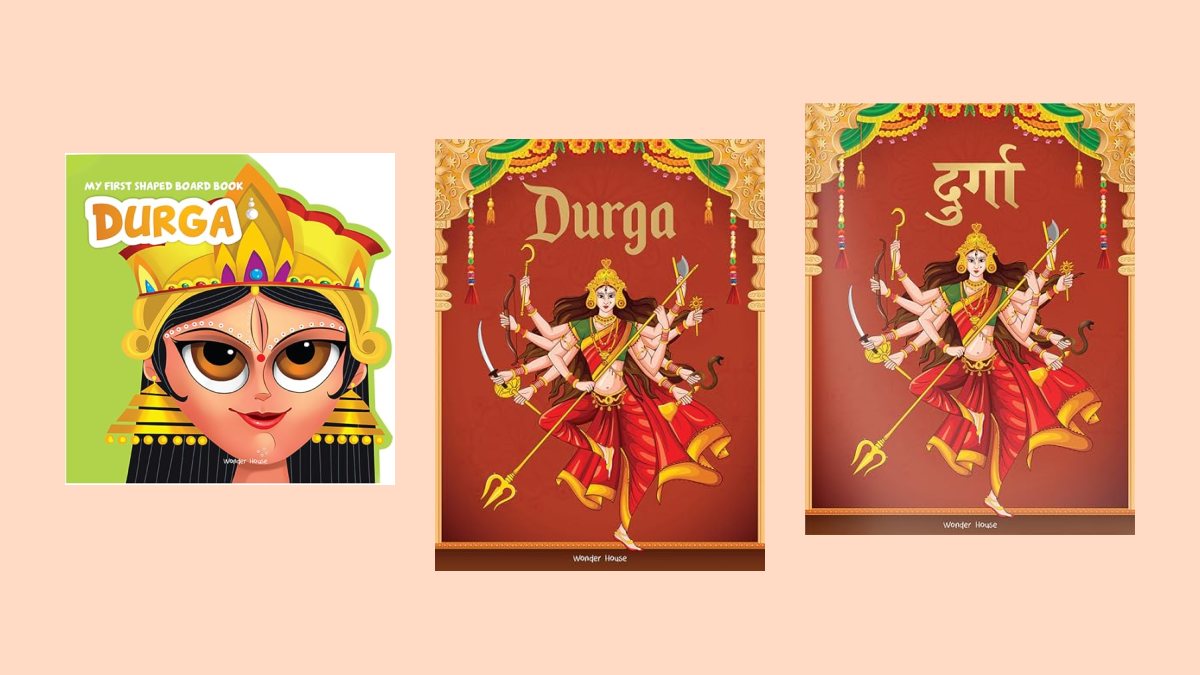
- My First Shaped Board Book: Goddess Durga: a sturdy, Durga shaped board book with bright pictures, perfect for small hands.
- My First Shaped Board Book: Kali: introduces Ma Kali gently, with simple words.
- My First Shaped Board Book: Saraswati: the goddess of learning, a lovely book to start the school year.
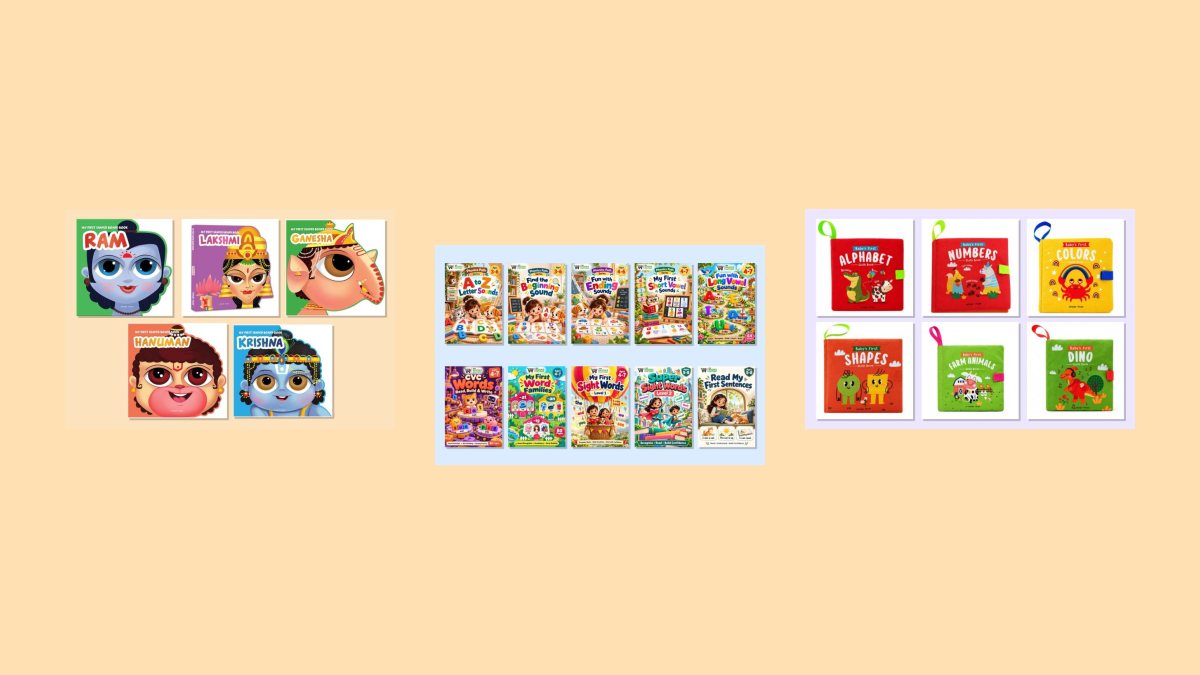
- My First Gods Board Book Combo: Ganesha, Krishna, Hanuman, Shiva and Durga together in one set.
For ages 4 to 8
- Tales from Durga For Children: the best known Durga stories, retold with colourful illustrations.
- Tales from Devis For Children: stories of many goddesses, including Lakshmi, Saraswati and Parvati.
- Durga: The Invincible One: an illustrated story book for confident young readers.
- Children's First Mythology Stories, Pack of 5: Devi, Durga, Arjuna and more in one value pack.
- Illustrated Mythology Gift Set: Durga, Ganesha and Hanuman: a ready made Navratri and Diwali gift.
- My First Library of Hindu Gods and Goddesses: a boxed set of 12 books for a full shelf of stories.
- Gods and Goddesses Spiritual Colouring Book: colour each goddess while you hear her story.
In Hindi
- Durga: Illustrated Story Book for Children in Hindi: Durga Maa ki kahaniyan, in simple Hindi with pictures.
- Devis: Illustrated Story Book for Children in Hindi: Devi kahaniyan for young Hindi readers.
- Shri Durga Charitra Aivam Chalisa: the life of Durga Maa along with the Durga Chalisa, for families who pray together during Navratri.
If your child loves Durga Maa, they will also enjoy our Ganesha stories for kids, about her clever son, and our Hanuman stories for kids. With Diwali only a few weeks after Dussehra, our Diwali story for kids is the perfect next read. You can also browse all our story books for kids.
Frequently asked questions
Why do we celebrate Navratri? We celebrate Navratri to honour Durga Maa and her victory over the demon Mahishasura after a battle of nine days and nights. It reminds us that good always wins over evil. The tenth day, Vijayadashami or Dussehra, celebrates her victory and also Lord Rama's victory over Ravana.
What are the 9 forms of Durga? The nine forms of Durga worshipped in Navratri are Shailaputri, Brahmacharini, Chandraghanta, Kushmanda, Skandamata, Katyayani, Kalaratri, Mahagauri and Siddhidatri. One form is worshipped on each night.
What is the difference between Navratri and Durga Puja? They celebrate the same goddess at the same time of year. Navratri, with fasting, garba and kanya pujan, is the name used in most of North and West India. Durga Puja is the name used in Bengal and East India, where the last five days are celebrated with pandals and idols of Durga and her children.
How do I explain Navratri to a small child? Keep it simple: "A brave goddess called Durga Maa fought a bad demon for nine nights and won, so we pray to her and celebrate for nine nights." Then read them one short Navratri story for kids each night.
Where can I buy Durga books for kids? You can buy books online at BooksFactory with cash on delivery, including Durga story books in English and Hindi, shaped board books for toddlers and mythology gift sets.
Start with one story tonight
Pick one of these seven Durga Maa stories and read it aloud tonight. Watch the gods join their light to create Durga, ride into battle with her lion and cheer when Mahishasura is defeated. Children who grow up with a Navratri story for kids each year learn that courage, patience and kindness always win in the end. Jai Mata Di, and happy reading.
0 Comments
Be the first to comment on this post.