


















Blog Article
Every year on the full moon of Kartik, gurdwaras across India light up, the sound of kirtan fills the streets before sunrise, and lakhs of families sit together for langar. This is Gurpurab, the birthday of Guru Nanak Dev Ji, the first Sikh Guru. In 2026, Guru Nanak Jayanti falls on Tuesday, 24 November (always check the date your local gurdwara follows), and it will be his 557th Prakash Purab.
For children, the best way to understand Guru Nanak is not through dates but through his stories, called sakhis. These short, true-to-tradition tales show a curious, kind and fearless boy who grew into a teacher of the whole world. Below you will find a simple introduction to his life, seven famous Guru Nanak stories for kids, each with its moral, and easy ways to celebrate Gurpurab at home.
Who Was Guru Nanak Dev Ji?
Guru Nanak was born in 1469 in the village of Talwandi, near Lahore. Today the town is called Nankana Sahib and it lies in Pakistan. His father, Mehta Kalu, was the village accountant, and his mother was Mata Tripta. His elder sister, Bebe Nanaki, loved him deeply and was the first person to understand that her little brother was special.
As a boy, Nanak asked questions that surprised his teachers. As a young man he worked as a storekeeper in Sultanpur Lodhi. Then, at about thirty, he began a life of travel and teaching. With his friend Bhai Mardana, who played the rabab, he walked thousands of kilometres on four great journeys called the Udasis, visiting Hindu pilgrim towns, Muslim holy places, mountains and deserts. Everywhere he went, he sang shabads (hymns) about one God who lives in every heart.
In his later years he settled at Kartarpur, on the banks of the river Ravi, where he farmed his own land and ran a free kitchen open to all. Before he passed away in 1539, he chose Bhai Lehna, renamed Guru Angad, as the next Guru. His hymns, including the Japji Sahib that Sikhs recite every morning, are part of the Guru Granth Sahib.
The Three Golden Rules of Guru Nanak
If your child remembers only one thing about Guru Nanak, let it be these three simple rules for living. They are easy enough for a five year old and deep enough for a grown up:
- Naam Japna: remember God, and be thankful, every day.
- Kirat Karni: work hard and earn honestly. Never cheat.
- Vand Chakna: share what you have with others, especially those in need.
He also taught that all people are equal, whatever their religion, caste, gender or wealth. That is why everyone sits together on the floor to eat in a langar. Keep these rules in mind as you read the stories below, because almost every sakhi is about one of them.
7 Famous Guru Nanak Stories for Kids
1. The True Bargain (Sacha Sauda)
When Nanak was a teenager, his father worried that the boy spent too much time thinking and praying and not enough time on business. So one day Mehta Kalu gave him twenty rupees, a large sum in those days, and said, "Go to the market in the next town. Buy goods, sell them for more, and make a good profit. Make a true bargain."
Nanak set out with his friend Bala. On the way, in a forest, they met a group of holy men who had not eaten for days. They were weak and thin. Nanak looked at the money in his hand and then at the hungry men. "My father asked me to make a true bargain," he said to Bala. "What could be truer than feeding the hungry?" He spent all twenty rupees on flour, ghee, lentils and blankets and served the holy men a meal.
When Nanak came home empty handed, his father was very angry. But Nanak calmly said he had made the most profitable deal of all. Today the gurdwara at that place is named Sacha Sauda, the true bargain, and many people see that meal as the seed of the langar.
Moral: the best use of what we have is to help someone who needs it.
2. The Cobra's Shade
As a boy, Nanak was sometimes sent to graze the family buffaloes in the fields. One hot afternoon, tired from the sun, he lay down under a tree and fell asleep. As the sun moved, the shade of the tree slipped away and the bright light fell on his face.
Rai Bular, the chief of the village, happened to ride past. He stopped in astonishment. A large cobra had come out of the grass and was holding up its wide hood over the sleeping boy's face, like an umbrella, shading him from the sun. The snake did not harm him at all. From that day Rai Bular became one of Nanak's greatest admirers and told Mehta Kalu that his son was no ordinary child.
Moral: a heart full of love and peace has nothing to fear, and kindness is felt even by animals.
3. Bhai Lalo and Malik Bhago
On his travels, Guru Nanak came to the town of Saidpur, now Eminabad. Instead of staying at a grand house, he chose to stay with Bhai Lalo, a poor carpenter who earned his living with his own hands. Lalo had little to offer, only simple rotis made from coarse grain, but he served them with love.
In the same town lived Malik Bhago, a rich and powerful official who had become wealthy by cheating and squeezing the poor. Bhago was holding a huge feast and invited all the holy men. When he heard that Guru Nanak had not come, he was offended and sent for him. "Why do you eat dry roti at a carpenter's house and refuse my rich food?" he asked.
Guru Nanak asked for one of Lalo's rotis and one of Bhago's fine puris. He held one in each hand and squeezed. From Lalo's roti came drops of milk. From Bhago's puri came drops of blood. Everyone fell silent. "Lalo's bread is earned with honest sweat," said the Guru. "Yours is made from what you took from others." Malik Bhago was ashamed, and he promised to change his ways.
Moral: honest work makes even simple food precious. This is the lesson of Kirat Karni.
4. Where Is God Not?
On one of his long journeys, Guru Nanak travelled to Mecca. Tired after the trip, he lay down to rest at night with his feet pointing towards the Kaaba, the holiest place for Muslims. A caretaker named Jiwan saw this and was furious. "How dare you point your feet towards the house of God!" he shouted.
Guru Nanak replied gently, "I am tired, friend. Please turn my feet in the direction where God is not." The man grabbed his feet and turned them around. The story says that wherever he turned the Guru's feet, the Kaaba seemed to be in that direction too. The caretaker understood the lesson and bowed his head.
Moral: God is not in one place or one building. God is everywhere and in everyone.
5. Three Days in the River
When Nanak worked in Sultanpur Lodhi, he went to bathe in the river Bein every morning before dawn. One day he went into the water and did not come out. His friends searched the banks and the river for hours. People feared he had drowned. Only his sister, Bebe Nanaki, kept faith that he would return.
On the third day, Nanak walked out of the river, calm and glowing. For a long time he said nothing. Then he spoke his first words: "There is no Hindu and there is no Musalman." He meant that in God's eyes we are all simply human beings, and that labels should never divide us. Sikhs believe that in the river he received his mission from God, and that the Mool Mantar, the opening lines of the Japji Sahib that begin with Ik Onkar (there is one God), came to him then. Soon after, he left his job and began his travels.
Moral: what we share as human beings is far bigger than the names that separate us.
6. Watering the Fields from Haridwar
Guru Nanak visited Haridwar during a big festival. Thousands of pilgrims were standing in the Ganga, throwing water towards the east, towards the rising sun. He asked them why. "We are sending water to our ancestors in heaven," they said.
Guru Nanak turned around and started throwing water towards the west. The pilgrims laughed. "What are you doing?" they asked. "My fields in Punjab are dry," he said. "I am watering them." "That is foolish," they said. "Your fields are hundreds of kilometres away. How can this water reach them?" Guru Nanak smiled. "If my water cannot reach my fields a few hundred kilometres away, how can yours reach your ancestors in another world?"
The crowd went quiet and began to think. He was not mocking their love for their ancestors. He was asking them to think for themselves rather than follow rituals without understanding.
Moral: ask questions and think for yourself. Real devotion is in the heart, not only in rituals.
7. Sajjan the Thug
In one town lived a man called Sajjan, whose name means "good friend". He had built a beautiful inn with a temple on one side and a mosque on the other, so that travellers of every faith would feel welcome. But Sajjan was not a good friend at all. At night he robbed his sleeping guests, and some were never seen again.
When Guru Nanak and Bhai Mardana stopped at the inn, Sajjan was delighted. These travellers looked important, so they must be carrying riches, he thought. That night, as he waited for them to sleep, Guru Nanak began to sing a shabad. It spoke of bright bronze that looks shiny but leaves black marks when you rub it, and of a person who looks good outside but is dark within. The words went straight into Sajjan's heart. He realised the song was about him.
Sajjan fell at the Guru's feet, weeping, and confessed everything. Guru Nanak told him that God forgives those who truly repent, but he must make amends. Sajjan gave away his stolen wealth to the poor and turned his inn into a place of worship and service. He became one of the first places where the Guru's message was shared.
Moral: anyone can change. It is never too late to choose the right path.
How Gurpurab Is Celebrated
Knowing what happens on the day makes the festival much more exciting for children. Here is what families usually see during Guru Nanak Jayanti:
- Akhand Path: a continuous reading of the whole Guru Granth Sahib, taking about 48 hours, ending on the morning of Gurpurab.
- Prabhat Pheri: early morning processions in the days before, with people singing hymns through the lanes.
- Nagar Kirtan: a big procession, usually the day before, led by five men representing the Panj Pyare, with the Guru Granth Sahib carried in a decorated palki, along with music and gatka (Sikh martial arts) displays.
- Kirtan and katha: singing of shabads and telling of sakhis, just like the ones above, in the gurdwara.
- Langar: a free community meal where everyone sits together, and volunteers cook, serve and clean. This is called seva, selfless service.
- Lights: gurdwaras and homes are lit with diyas and lights in the evening.
If your family celebrates Diwali, your child may enjoy knowing that Sikhs celebrate Bandi Chhor Divas on the same day, remembering Guru Hargobind's release from Gwalior Fort. You can read more festival stories in our post on why we celebrate Diwali.
5 Easy Ways to Celebrate Gurpurab With Kids at Home
- Tell one sakhi a night. Start a week before Gurpurab and tell one of the seven stories above each night at bedtime. On the day itself, ask your child to tell you their favourite one.
- Cook and share. Make simple kada prasad or a meal together and share it with neighbours, the building guard or a family that needs it. That is Vand Chakna in action.
- Visit a gurdwara. Everyone is welcome. Cover your head, remove your shoes, and let your child help serve water or roll rotis in the langar if the sevadars allow.
- Make a true bargain jar. Give your child a few coins and let them decide how to spend them to help someone, just like the Sacha Sauda story.
- Learn one line. Teach older children the first words of the Mool Mantar, Ik Onkar, and explain its meaning: there is one God, who lives in all of us.
Best Books to Read About Guru Nanak and Sikh Teachings
Stories stay with children when they can return to them in a book. Here are titles on our site, from picture books for little ones to readings for the whole family.
For young children
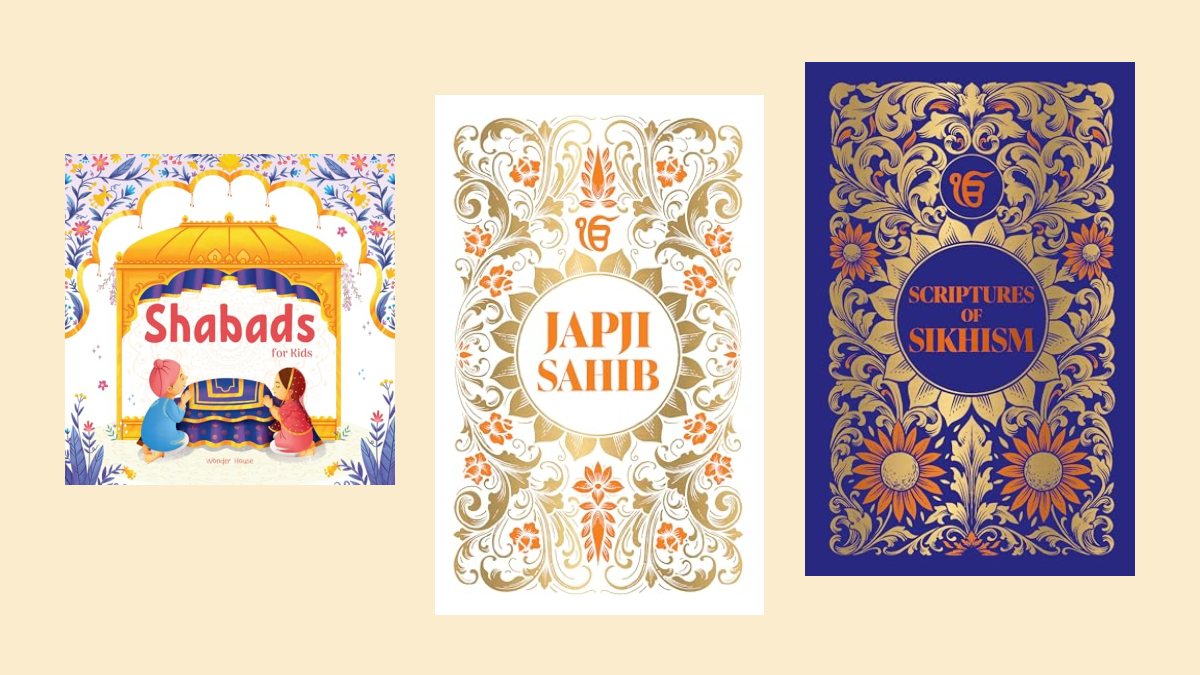
- Shabads For Kids: Selected Sikh Hymns in Two Languages, for age 3 and up, with simple hymns side by side in two languages. A lovely first book for Gurpurab.
- The Birthday of Guru Nanak, a gentle introduction to the festival itself.
- Guru Nanak: The First Sikh Guru, the story of his life told for young readers.
- Guru Nanak's Blessed Trail, which follows his travels across the land.
For older children and the family
- Japji Sahib (Deluxe Hardbound Edition), the morning prayer composed by Guru Nanak, a beautiful edition to keep at home.
- Japji Sahib: Way to God in Sikhism, Book 1, with meaning and explanation, ideal for parents who want to explain the verses.
- Scriptures of Sikhism: Japji Sahib, Asa Di Var, Rehras Sahib and Sohila, four daily prayers in one hardbound volume.
- Asa Di Var: Way to God in Sikhism, Book 2, another of Guru Nanak's great compositions, explained.
- The Sikh Images of Heritage, a richly illustrated book on Sikh history and heritage that children enjoy looking through.
For more short tales with a lesson, see our collection of moral stories for kids, and the post on Gautam Buddha stories for kids, another great teacher from India who taught kindness and equality. You can also browse all our story books for kids.
Frequently Asked Questions
When is Guru Nanak Jayanti in 2026?
Guru Nanak Jayanti is celebrated on Kartik Purnima, the full moon of the month of Kartik. In 2026 it falls on Tuesday, 24 November, according to most calendars. Some gurdwaras follow a different calendar, so check locally.
Why is Guru Nanak Jayanti called Prakash Purab?
Prakash means light. The day is called Prakash Purab because Sikhs believe Guru Nanak's birth brought the light of truth and knowledge into a world darkened by hatred and division.
What is the main teaching of Guru Nanak for children?
The simplest way to put it: remember God, work honestly, and share with others. And treat every person as equal, because the same God lives in all of us.
What are sakhis?
Sakhis are traditional stories from the lives of the Sikh Gurus. They have been told by grandparents and in gurdwaras for centuries, and each one carries a lesson about how to live.
This Gurpurab, sit with your children, light a diya, and share a story. A boy who fed hungry strangers with his father's money, who reminded the world that God is everywhere, and who taught a robber to become good, is a hero every child can look up to. Happy Gurpurab to you and your family.




0 Comments
Be the first to comment on this post.