

















Blog Article
More than 2,500 years ago, a prince in a palace at the foot of the Himalayas gave up his crown, his riches and his comfortable life to find an answer to one question: why do people suffer, and how can they be free of it? That prince became the Buddha, which means "the awakened one", and his gentle teachings spread from India across all of Asia and the world.
Children love Buddha stories because they are short, calm and full of simple wisdom. There are no great battles in them. Instead, there is a wounded swan, a grieving mother, a robber who changes his heart, and a lake of muddy water. Below you will find a short life story of Gautam Buddha, seven famous Gautam Buddha stories for kids with their morals, three favourite Jataka tales, and the best books to keep reading.
Who Was Gautam Buddha? A Short Life Story for Kids
Gautam Buddha was born as Prince Siddhartha Gautama in Lumbini, a garden in what is now Nepal. His father, King Suddhodana, ruled the Shakya kingdom from the city of Kapilavastu, and his mother was Queen Maya. A wise man told the king that the baby would become either a great ruler or a great teacher. The king wanted a ruler, so he kept Siddhartha inside the palace and made sure he never saw sadness or pain.
Siddhartha grew up clever, kind and strong. He married Princess Yashodhara and they had a son, Rahul. But at the age of 29, after seeing the world outside the palace, he left home to search for the truth. After six years of searching, he found enlightenment under a peepal tree at Bodh Gaya in Bihar. He gave his first teaching at Sarnath, near Varanasi, and spent the next 45 years walking from village to village, teaching kings and farmers, rich and poor, in the same simple words. He passed away at Kushinagar at the age of 80.
These four places, Lumbini, Bodh Gaya, Sarnath and Kushinagar, are still visited by pilgrims from all over the world. His birthday, enlightenment and passing are all remembered on one day, Buddha Purnima, the full moon of Vaisakh, usually in April or May.
7 Famous Gautam Buddha Stories for Kids
1. Prince Siddhartha and the Wounded Swan
One morning young Siddhartha was walking in the palace garden when a beautiful white swan fell from the sky and landed at his feet. An arrow was stuck in its wing. Siddhartha gently pulled out the arrow, washed the wound and wrapped the bird in his shawl to keep it warm.
Just then his cousin Devadatta came running with his bow. "That swan is mine," he shouted. "I shot it, so give it to me." "No," said Siddhartha softly. "If you had killed it, it might be yours. But it is alive, and I saved it, so it belongs with me." The two boys took their argument to the king's court. The wise ministers listened to both sides and gave their judgement: "A life belongs to the one who saves it, not to the one who tries to take it." Siddhartha cared for the swan until it was well, and then set it free.
Moral: it is always better to save a life than to harm one. Kindness to animals is a sign of a good heart.
2. The Four Sights
Siddhartha had never left the palace grounds. One day he asked his charioteer, Channa, to take him into the city. On the road he saw a bent old man with white hair, leaning on a stick. "What is wrong with him?" asked the prince. "He is old," said Channa. "Everyone grows old one day." On another trip he saw a man lying sick with fever, and learned that anyone can fall ill. On a third, he saw a funeral and learned that every living thing must one day die.
The prince was deeply troubled. Then, on a fourth trip, he saw a monk in a simple robe, walking calmly with a peaceful smile, though he owned nothing at all. Siddhartha decided that he too would leave the palace and search for a way to end suffering. One night, he quietly said goodbye to his sleeping wife and son and rode away. This is called the Great Departure.
Moral: real happiness does not come from money or comfort. Opening our eyes to the pain of others is the first step to wisdom.
3. The Middle Way and the Musician's Lute
For six years Siddhartha tried to find the truth by starving himself and living without any comfort at all. He grew so thin he could barely stand. One day, sitting by a river, he heard a music teacher in a passing boat speaking to his student. "If you tighten the string of the lute too much, it will snap. If you leave it too loose, it will not play. Only when it is just right does it make sweet music."
Siddhartha understood. Life is the same. Too much comfort makes us lazy and greedy, and too much hardship breaks us. The right path is in the middle. Just then a kind village girl named Sujata offered him a bowl of kheer, rice cooked in milk. He accepted it gladly and grew strong again. He then sat under a peepal tree at Bodh Gaya and promised not to rise until he understood the truth. On the night of the full moon, he became enlightened. That tree became known as the Bodhi tree, the tree of awakening.
Moral: balance is the key. Neither too much nor too little; follow the middle way.
4. Kisa Gotami and the Mustard Seed
A young mother named Kisa Gotami lost her only baby to illness. Mad with grief, she carried the child from house to house, begging for medicine to bring him back. Someone sent her to the Buddha. "Please help me," she cried. "Bring my son back to life."
The Buddha said kindly, "I will help you. Bring me a handful of mustard seeds, but they must come from a house where no one has ever died." Kisa Gotami ran to the village with hope. At every door, people were happy to give her mustard seeds, but when she asked, "Has anyone ever died in your home?" each family said yes. One had lost a father, another a grandmother, another a child. By evening she understood. Death comes to every family, and she was not alone in her sorrow. She returned to the Buddha, calm at last, and became his follower.
Moral: everyone faces loss. Sharing our sadness with others helps us heal.
5. Angulimala the Robber
In the forest of Kosala lived a fearsome robber named Angulimala. His name means "garland of fingers", because he wore a necklace of fingers taken from the people he attacked. Travellers were so afraid that no one dared to use the forest road. One day the Buddha set out alone down that very road. The villagers begged him not to go.
Angulimala saw the monk and ran after him with his sword. But however fast he ran, he could not catch up with the Buddha, who was only walking slowly. "Stop, monk! Stop!" he shouted. The Buddha turned and said calmly, "I have stopped, Angulimala. It is you who have not stopped." "What do you mean?" asked the robber. "I have stopped hurting living beings," said the Buddha. "You have not."
The words shook Angulimala to his core. He threw his sword into a ditch, knelt before the Buddha and asked to become his disciple. He spent the rest of his life as a gentle monk, helping the very people who had once feared him.
Moral: no one is beyond change. Calm courage and kindness are stronger than any weapon.
6. The Gift of Anger
Once, an angry man came to the Buddha and shouted insults at him in front of everyone. He called him a fraud and worse. The Buddha listened quietly and did not say a word. When the man finally ran out of breath, the Buddha asked him a question. "If you bring a gift for someone, and that person does not accept it, to whom does the gift belong?"
"To me, of course," said the man. "I brought it." The Buddha smiled. "Then I do not accept your anger. It still belongs to you." The man was ashamed. He went home, thought about it all night, and came back the next day to say sorry.
Moral: we do not have to accept someone else's anger. Staying calm keeps us free.
7. The Muddy Water
One day the Buddha and his disciple Ananda were travelling and stopped by a small lake. "I am thirsty," said the Buddha. "Please fetch me some water." Ananda went to the lake, but a bullock cart had just crossed it and the water was brown and muddy. He came back and said the water was not fit to drink.
After some time, the Buddha asked him to go again. The water was still a little cloudy. Ananda came back. Half an hour later, the Buddha sent him once more. This time the mud had settled to the bottom and the water was crystal clear. Ananda brought it back, and the Buddha said, "See what you did? You let it be, and the mud settled on its own. Your mind is the same. When it is upset, do not stir it. Give it a little time, and it will become clear."
Moral: when you are angry or upset, wait and breathe. A calm mind sees the answer clearly.
3 Favourite Jataka Tales for Kids
The Jataka tales are a collection of more than 500 stories about the Buddha's earlier lives, when he was born as an animal or a person and showed great wisdom and kindness. Many of them, like the Panchatantra fables, use animals to teach a lesson. Here are three children always love.
The Monkey King's Bridge
A monkey king lived with his troop in a giant mango tree by the river. One day the king of Varanasi saw the sweet mangoes and sent his archers to surround the tree. The monkeys were trapped. The monkey king tied a long vine to his feet, leapt across to a tree on the other bank, and held on to a branch with his hands. His body became a living bridge, and all eighty thousand monkeys ran across his back to safety. Badly hurt, he fell. The human king, moved by such selflessness, cared for him and learned that a true leader puts his people first.
Moral: a real leader serves others before himself.
The Hare in the Moon
A hare, a monkey, a jackal and an otter lived together as friends and promised to give food to anyone in need. A hungry old man came by. The monkey brought fruit, the otter brought fish and the jackal brought milk. The hare had only grass, which a man cannot eat. So the hare said, "Light a fire, and I will give you myself." He jumped into the flames, but the fire did not burn him. The old man was actually the god Sakka, testing their kindness. To honour the hare's generosity, he drew the hare's picture on the moon, where we can still see it on a full moon night.
Moral: true giving comes from the heart, whatever we have.
The Talkative Tortoise
A tortoise who loved to talk made friends with two geese. When the lake began to dry up, the geese offered to carry him to a new lake. They held a stick in their beaks and told the tortoise to bite the middle and hold on, but never to open his mouth. As they flew over a village, children pointed and laughed, "Look, the geese are carrying a tortoise!" The tortoise could not stay quiet. He opened his mouth to reply, let go of the stick and fell to the ground.
Moral: think before you speak. Sometimes silence is wiser than words.
Simple Teachings of Buddha for Children
The Buddha's teachings can sound deep, but children can practise them every day. Here is a simple version you can stick on the fridge:
- Do not hurt any living being. Be gentle with people, animals and even insects.
- Tell the truth. Honest words build trust.
- Do not take what is not yours. Ask before you borrow.
- Be thankful for what you have, and share it.
- When angry, stop and breathe, like the muddy water, and let your mind settle.
- Choose the middle way. Not too much screen time, not too much sweets, not too little sleep.
A great way to begin is a two minute quiet time before bed. Ask your child to sit still, close their eyes and simply count ten slow breaths. It is the easiest form of the meditation the Buddha taught, and it helps children fall asleep calmly.
Best Buddha Story Books for Kids
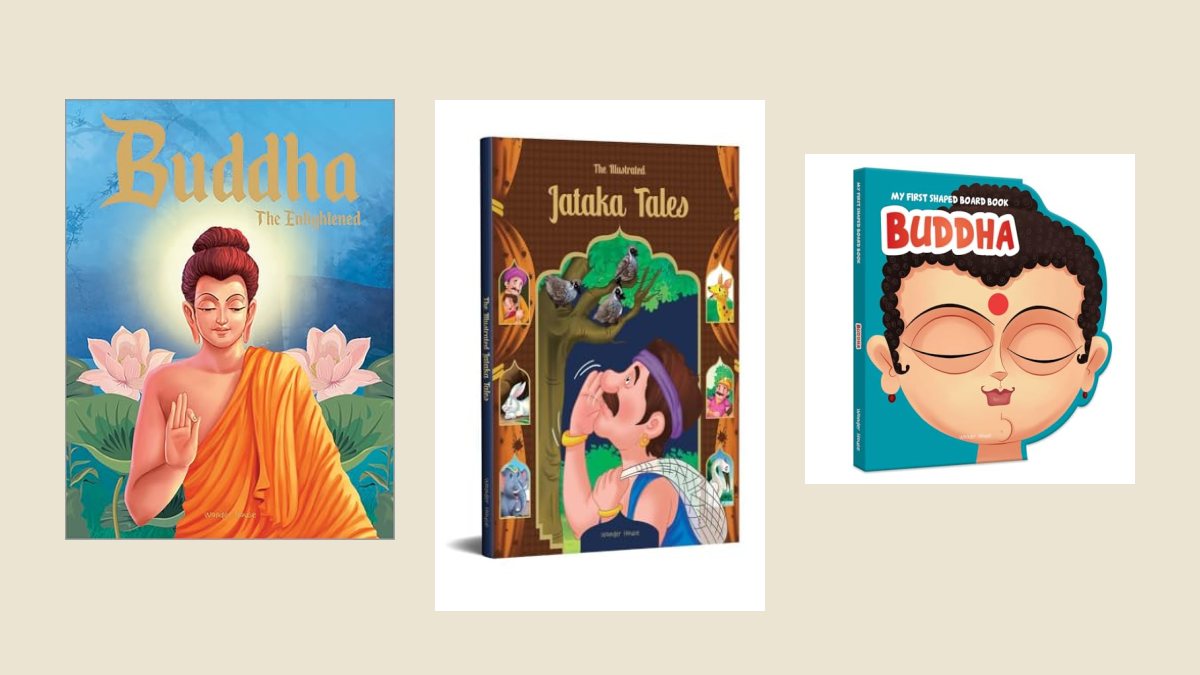
The stories above are just the beginning. These books on our site bring the Buddha's life and the Jataka tales to children with pictures and simple words.
For little ones (age 2 to 5)
- My First Shaped Board Book: Illustrated Buddha, a sturdy picture book shaped like the Buddha, perfect for toddlers.
For children (age 5 to 12)
- Buddha: The Enlightened, Illustrated Stories From Indian History and Mythology, the full life story with colourful pictures.
- Gautam Buddha: Illustrated Stories in Hindi, the same lovely stories for children who read in Hindi.
- The Illustrated Jataka Tales: Classic Tales From India, a collection of the best Jataka stories with pictures.
- Indian Wisdom Tales Combo: Akbar Birbal, Tenali Raman and Jataka Tales, three books of clever and kind stories in one set.
For teens and parents
- Siddhartha by Hermann Hesse (Deluxe Hardbound Edition), the classic novel about a young man's search for meaning in the time of the Buddha.
- The Gospel of Buddha, the Buddha's teachings and parables retold simply.
- Buddha: Spirituality For Leadership and Success, lessons from the Buddha for life and work.
- Buddha Wisdom Library (Boxed Set), a gift set for anyone who wants to go deeper.
If your child enjoys these, they will also love our Panchatantra stories for kids, which share several tales with the Jatakas, and our collection of moral stories for kids. For another great teacher who taught that all people are equal, read our Guru Nanak stories for kids, perfect for Gurpurab. You can also browse all our story books for kids.
Frequently Asked Questions
What is the most famous story of Buddha for kids?
The story of Prince Siddhartha and the wounded swan is usually the first one children hear, because it is short and teaches kindness to animals. Angulimala and Kisa Gotami are the next most popular.
What are Jataka tales?
Jataka tales are ancient Indian stories about the earlier lives of the Buddha, often as an animal such as a monkey, deer or hare. Each one teaches a value like kindness, honesty or courage, which makes them ideal bedtime moral stories.
When is Buddha Purnima?
Buddha Purnima falls on the full moon of the month of Vaisakh, usually in April or May. It celebrates the Buddha's birth, enlightenment and passing.
At what age can children read Buddha stories?
Picture books work from age 2 or 3. Illustrated story books suit children from 5 to 10, and older children and teens can move on to fuller retellings and novels like Siddhartha.
The Buddha once said that a jug fills drop by drop. So does a child's heart. Read one of these Buddha stories tonight, talk about the moral together, and let the drops of wisdom add up, one story at a time.




0 Comments
Be the first to comment on this post.